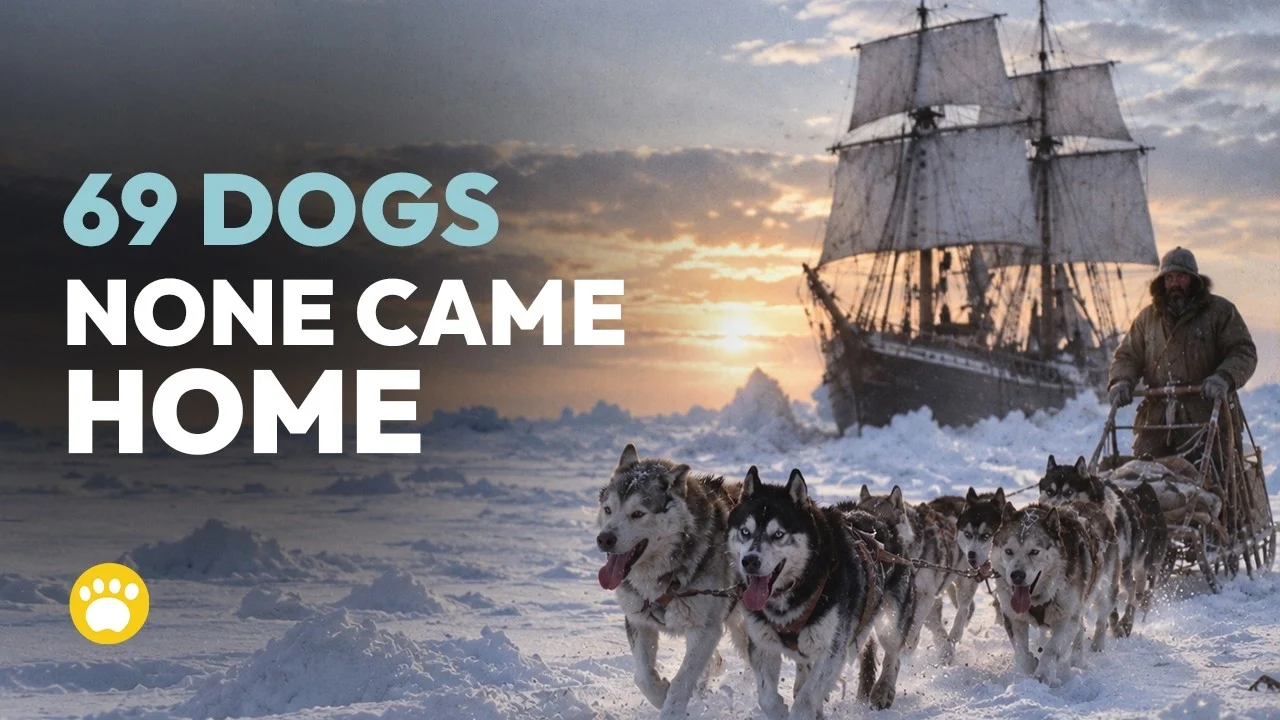
Look at almost any famous photograph from the age of Antarctic exploration and you will find dogs in it: chained to a deck rail, curled in the snow beside a ship locked in ice, harnessed to a sledge. Here is the part most people never learn. Of the sixty-nine dogs that sailed south with Ernest Shackleton, not one came home. All of the men did.
Scott’s dogs and the crevasse
For his 1910 expedition, Robert Falcon Scott sent Cecil Meares to Siberia to buy dogs. Meares came back with 33 Siberian huskies. One of them, Osman, had been delivering mail by sledge across the Sea of Okhotsk.
On February 21, 1911, Scott, Meares and two others took a shortcut across ground known for crevasses. Osman made it across; behind him the surface collapsed and the dogs dropped into the gap still in their harnesses. Two fell onto a ledge sixty feet down. Scott had himself lowered on a rope to get them and found both curled up asleep, unhurt.
Every dog survived, but the day changed Scott. Until then he had talked about dogs taking him to the Pole. Afterward he never said it again. His final push was made by men dragging their own sledges. He and four companions reached the Pole on January 16, 1912, and died on the way back.

Amundsen’s opposite choice
Roald Amundsen left base on October 19, 1911, with 52 dogs, planning in advance that most would be shot along the way and fed to the survivors and the men. At a camp they named the Butcher’s Shop, 24 were killed. Amundsen reached the Pole on December 14, 1911, and came back with eleven dogs and men who had gained weight.

Shackleton’s dogloos
Endurance left South Georgia on December 5, 1914, with 27 men, a stowaway, 69 dogs and a tomcat called Mrs. Chippy. On January 19, 1915, the ship was caught in pack ice in the Weddell Sea and stayed stuck for ten months.
So the men built a town for the dogs. They stacked ice blocks into igloo shapes, covered them with boards or frozen sealskins and poured water over them to freeze solid. They called them dogloos; the puppy versions were puploos. One dog, Sailor, got a small church with a spire. On June 15, 1915, the crew staged a sledge race called the Antarctic Derby and bet in chocolate and cigarettes, because money was useless out there.
The photographs that survived
All of it was photographed by Frank Hurley. When Endurance was sinking, he waded into three feet of slush inside the wreck for his sealed cases of negatives. Then Shackleton made him choose. On November 9, 1915, they kept 120 plates, and Hurley smashed about 400 others so he couldn’t change his mind.
The dogs ran out of time first
Seal meat grew scarce on the drifting floes. In January 1916, Shackleton ordered all but two teams shot, about thirty dogs, and called it the worst job of the expedition. The last were killed in early April 1916, days before the crew reached Elephant Island. All 28 men got out alive.
Sled dogs in Antarctica
- 1899 Dogs begin working the continent
- 1911 Amundsen reaches the Pole by dog team
- 1914–16 Endurance: 69 dogs, none return
- 1991 Madrid agreement: non-native animals must leave
- Feb 22, 1994 The last 14 huskies fly out of Rothera
The end of an era
An agreement signed in Madrid in 1991 required every non-native animal to be removed, partly over fears that canine distemper could spread to Antarctic seals. Dogs had worked that continent for almost a full century. The photographs are now the only place any of them are still pulling.