
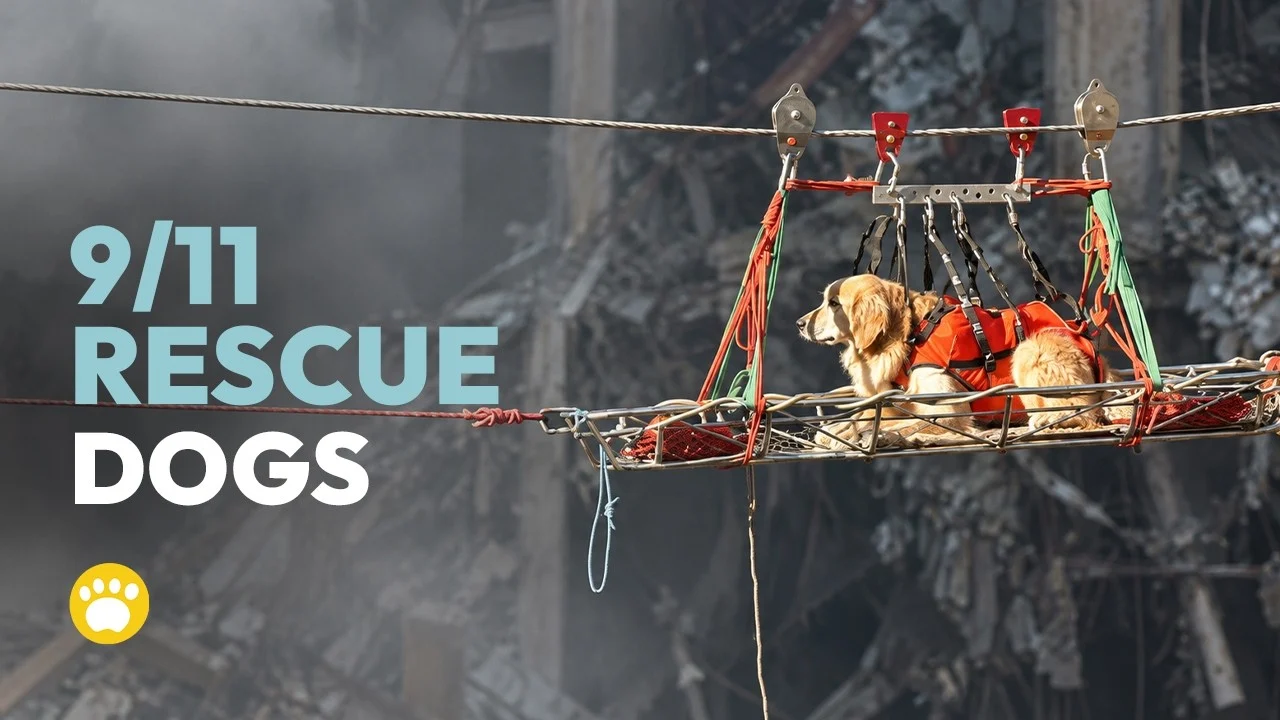
An order given at Ground Zero sounds absurd until you understand the reason. Rescue workers were told to climb into the rubble, hide in the debris and wait to be found. Not because they were trapped, but because the dogs needed to find somebody. And the people giving that order were worried about the wrong thing, as a study of 95 of these dogs would prove nineteen years later.
The largest deployment of its kind
More than 300 search and rescue dogs worked the sites connected to the September 11 attacks in 2001. Roughly 100 were federally deployed teams, believed to be the largest deployment of its kind in American history, from task forces in Texas, Pennsylvania, Florida, Indiana and Washington state, and from as far as Canada and France.
Why search dogs need to win
A search dog is playing a game. From the first weeks of training, a puppy watches someone run off and hide, races to find them, and the instant it succeeds, a ball comes out or a game of tug starts. The hiding places get harder and the distances longer, but the structure never changes: hidden human, successful find, celebration. It only works because the dog keeps getting to win.
Twenty-seven hours after the towers fell, a German shepherd named Trakr alerted on a point in the debris. Rescuers dug and reached Genelle Guzman-McMillan, buried roughly thirty feet down, the last living person recovered from the site. Every dog that arrived after would search for weeks without finding anyone alive.

Mock finds
Handlers watched their partners lose drive and slow down. From the dog’s point of view, the game had broken. So handlers staged mock finds: a rescue worker hid in the debris, a dog was sent to find them, and everyone erupted in praise as if a life had just been saved. Veterinarian Cynthia Otto, who cared for the animals on site, explained that in training these dogs never search for hours without finding anybody, and you have to remind them every so often that they do get to win.
Riley’s basket ride
One of the most reproduced photographs from the recovery shows a golden retriever named Riley strapped into a rescue basket, riding a rope line across a canyon of debris about sixty feet deep, on September 15, 2001. Riley was trained to find the living, so everything he found was a failure by his own standards. But when firefighters put their arms around him and cracked a brief smile, his handler said, the dog was succeeding at something else entirely.

Sirius, the dog who never came out
Sirius was a yellow Labrador, an explosives detection dog stationed in the basement below the South Tower with Lieutenant David Lim. When the first plane hit, Lim secured him in his kennel, told him he’d be back, and went to help evacuate. Lim survived the collapse and was pulled from a stairwell about five hours later. He couldn’t reach his partner. Sirius was recovered in January 2002 and carried out under a full honor guard.
What everyone got wrong
A rumor spread that the dust was killing these dogs young. Otto tracked 95 deployed dogs against 55 who never went, with annual exams for years. The findings, published in September 2020: deployed dogs did carry more particles in their lungs, but they didn’t die younger or develop more cancer, and the leading causes of death in both groups were ordinary old age.
The takeaway
What nearly broke these dogs was never the air. It was going to work every day and finding nobody alive. Bretagne, two years old when she worked the pile, died on June 6, 2016, at sixteen. Firefighters lined the sidewalk and saluted as she walked into the clinic, and again when she came out under an American flag.


