Most people who see a Schipperke for the first time assume it was born without a tail. Breeders believed that for generations too. Then an English breeder went through the records of early litters and counted every puppy, and the numbers did not match the story at all.
We will get to those numbers. First, it helps to know what kind of dog this is, because this small black dog from Belgium is a lot more complicated than it looks.
Schipperke at a glance
- Height Males 11 to 13 inches, females 10 to 12 inches
- Weight Usually 10 to 16 pounds
- Coat Black, double coat with a ruff around the neck
- Lifespan Median of about 13 years
- Exercise At least 30 to 60 minutes a day
- Origin Belgium
How to say it and what the name means
In the United States, the name is usually pronounced SKIP-er-kee. In Belgium it sounds closer to SHIP-er-kuh.
The best-known explanation is that the name means little captain, because schip is the Flemish word for boat. The story goes that these dogs rode on the canal barges between Brussels and Antwerp, where they barked at strangers, kept the boats free of rats and nipped at the heels of the horses that towed the barges.
Many Belgian experts disagree. They say the name comes from an old Flemish word for shepherd, which would make it little shepherd. The official breed standard used in Belgium and most of Europe goes with that meaning. Some historians even argue the little captain story was made popular by English fanciers, and at least one barge operator from the 1930s said Schipperkes were never regular barge dogs at all. Both versions still have supporters.
Where the breed came from
The argument over the name ties into a bigger question about the breed’s roots. Belgian breed clubs and judges point to an extinct black sheepdog called the Leuvenaar, named after the city of Leuven. In their view, the same ancestor also produced the larger black Belgian Sheepdog, which would make the Schipperke its scaled-down cousin.
DNA studies complicate that picture. A large 2017 study of dog breed relationships placed the Schipperke closer to the Pomeranian and other small spitz-type breeds than to the Belgian herding dogs. Some researchers note that traces of Belgian Shepherd DNA show up too, so both stories may hold part of the truth.
The breed’s documented history goes back a long way. Shoemakers in Brussels were known for their small black dogs and held informal shows for them on Sundays as early as the late 1600s. Queen Marie Henriette of Belgium took an interest in the breed in 1885, which made it fashionable, and the first Schipperkes reached the United States in 1888.

Size and that unusual coat
Males stand about 11 to 13 inches at the shoulder and females about 10 to 12 inches. Most weigh between 10 and 16 pounds, which puts them in the same range as a large cat.
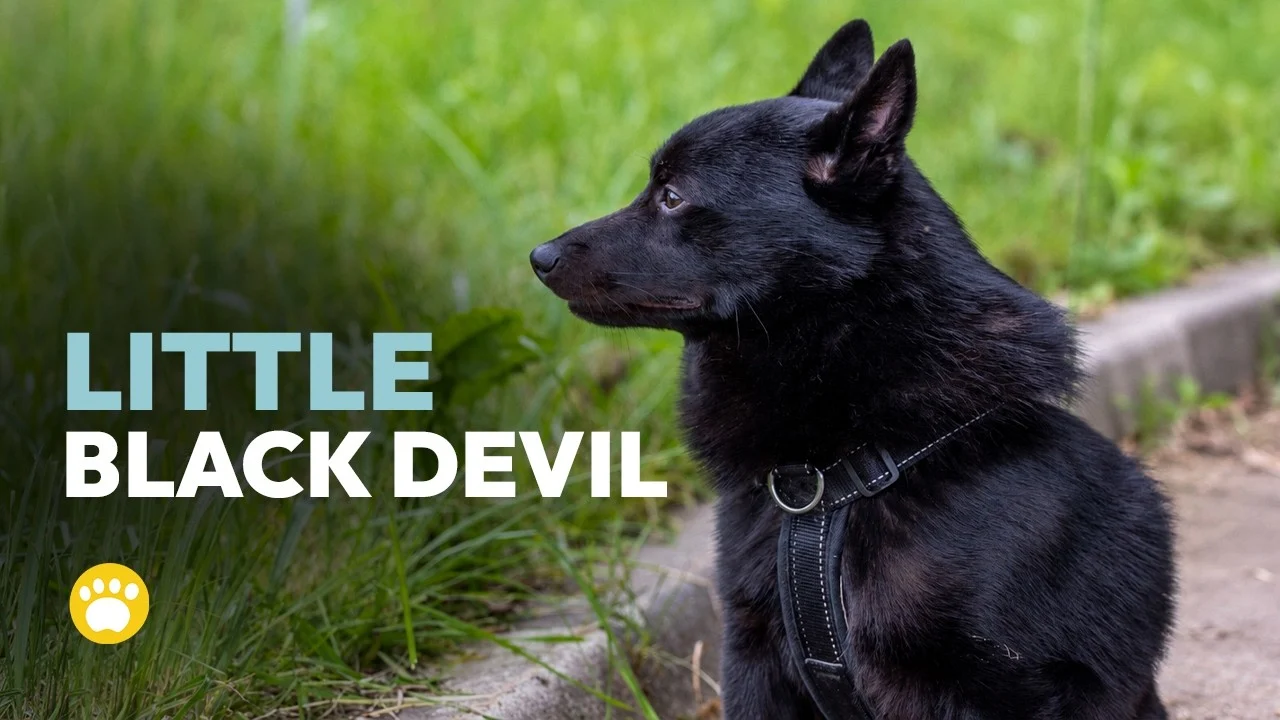
The coat is what makes them look the way they do. The American breed standard calls for several hair lengths in a set pattern. The hair is short on the face and ears, medium on the body, and longer around the neck, chest and back of the thighs. The thick fur around the neck is called the ruff, and the longer hair on the back legs is called the culottes, a French word for a type of short pants. Together they give the dog a sloping outline, as if it were bigger in front.
The coat is meant to stay natural. Heavy trimming is frowned on in the show ring. Expect regular brushing and a heavy shed once or twice a year.
Personality: the little black devil
Schipperkes carry the nickname little black devil, and many owners say it fits. They are curious about everything, they like to be in charge and they bark at anything new. The American Kennel Club describes the breed as a faithful little watchdog.
A Schipperke usually treats its home and family as something it has been assigned to guard. It tends to be wary of strangers, so early socialization with new people, places and sounds makes a big difference. They are usually friendly with other dogs they know.

Exercise and the escape problem
That energy has to go somewhere. Most guides recommend at least 30 to 40 minutes of exercise a day, and many owners give an hour. Puzzle toys and short training games help too, because a bored Schipperke gets loud and destructive.
They are also known as escape artists. They dig under fences, climb over them and figure out gate latches. A secure yard, supervision outside and a leash on walks are a must.
Training takes patience. These dogs are smart but stubborn, and they do not obey just because you asked. Short, consistent sessions with rewards work much better than harsh corrections.
Health and lifespan
For a small dog, the Schipperke lives a long time. A UK Kennel Club health survey found a median lifespan of 13 years, with about one in five dogs reaching 15 or older. The survey sample was small, so treat that figure as a rough guide.
The main breed-specific concern is an inherited brain disorder called MPS IIIB. Signs usually appear between 2 and 4 years of age, starting with balance problems such as trouble on stairs, and the disease gets worse over time. It is recessive, so a puppy has to inherit the faulty gene from both parents to be affected. A DNA test identifies carriers, and responsible breeders test both parents before breeding.
Other problems seen in the breed include kneecaps that slip out of place, hip problems, eye disease and low thyroid function. Ask any breeder for health test results on both parents.
The truth about the tail
Now, back to that tail. The English breeder who checked the early litter records counted 323 puppies. Only 16 were born with no tail at all. Another 120 had short stumps, and 187 had full tails. That means more than half were born with complete tails.
Most of the tailless dogs people remember had been docked, meaning the tail was cut off when they were puppies. The short natural stump comes from a single dominant gene, called the T-box gene, which also causes natural bobtails in some other breeds. One copy shortens the tail. Two copies are usually fatal before or soon after birth, which is why breeders avoid pairing two bobtailed dogs. The UK Kennel Club now has an official DNA test for it.
Docking is banned in Belgium, the UK and much of Europe, so the full tail is now a common sight there. A full Schipperke tail curls up over the back. So if you see one with a curled tail, nothing is wrong with the dog. That is how most of them are born.