
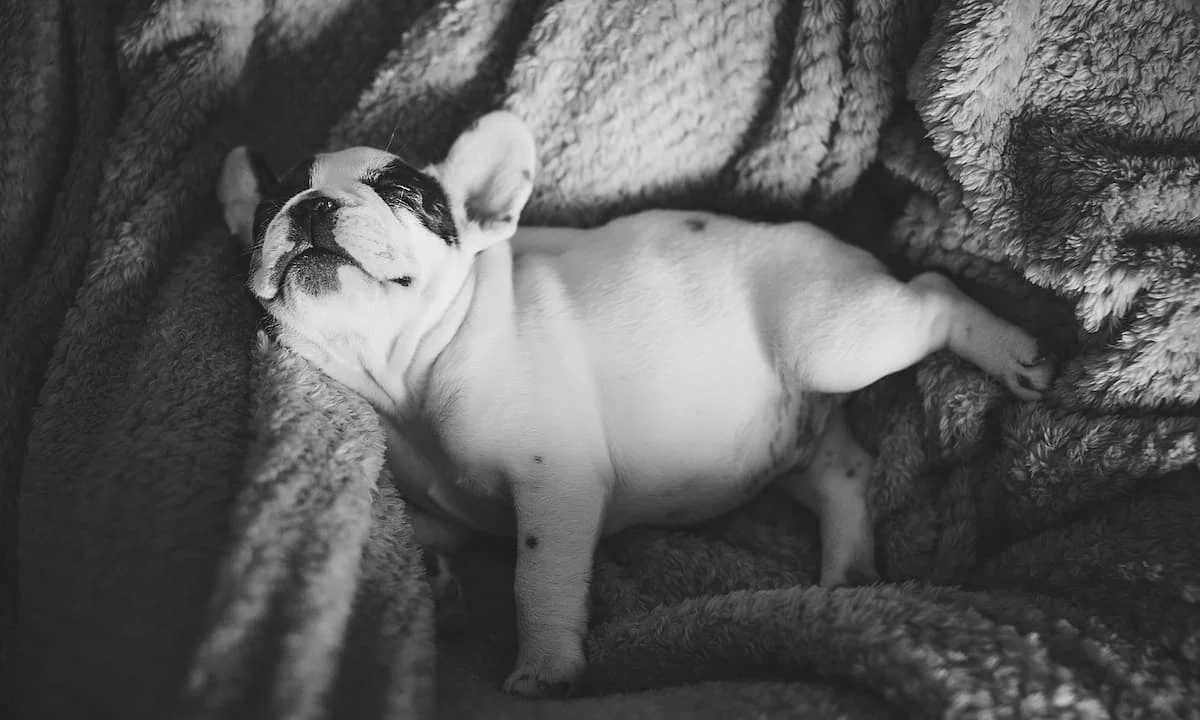
Kneading is usually thought of as a cat habit. A cat steps up and down on a soft blanket, pushing with one front paw and then the other, which people often call “making biscuits.” Plenty of dogs do the same thing. They press their paws into a blanket, a cushion or a stuffed toy, sometimes while sucking or mouthing the fabric, and often just before they fall asleep.
For most dogs it is a comforting habit with roots in the first weeks of life.
It starts at the mother’s side
Newborn puppies push against their mother’s belly with their front paws while they nurse. Veterinary sources, including VCA Animal Hospitals, describe this as a way of helping the milk flow. It may also help a puppy push the mother’s body back slightly so it can breathe while it feeds. A veterinary textbook on dog behavior notes that this front-leg pushing is strongest in very young puppies and fades by about 17 days of age.
Nursing is warm, safe and filling, and the kneading motion becomes linked to that comfort. Many dogs keep the habit, or come back to it, long after they are weaned. When an adult dog kneads a soft blanket, it is often reliving that early sense of calm.
Common reasons adult dogs knead
Winding down for sleep
The most common time for kneading is just before a nap or bedtime. Owners often describe their dog kneading a blanket or toy for a few minutes, slowing down, and then falling asleep. The repeated motion seems to help some dogs relax, much like a child rubbing a favorite blanket.
Making the bed comfortable
Dogs also use their paws to shape their bed. Pushing, pawing and scratching can flatten a lumpy blanket, bunch it up into a pillow, or push it aside to reach a cooler surface. This is closely related to the circling and digging many dogs do before lying down, a leftover from wild ancestors that flattened grass and leaves to make a sleeping spot.
Leaving their scent
Dogs have sweat glands in the pads of their feet. When a dog presses its paws into its bedding, some of its scent rubs off. A bed that smells like the dog may feel more familiar and secure. This is a widely repeated idea, though it has not been studied closely in dogs.
Self-soothing when stressed
Some dogs knead more when they are anxious, such as when they are left alone, during a storm, or after a move to a new home. The steady, repeated motion can help them calm down.
Weaned too early
Puppies that were taken from their mother and littermates very young, before about 8 weeks, seem more likely to keep kneading and sucking on soft things as adults. Many owners call this “nooking” or “cobbing” when a dog sucks on a blanket or toy while kneading it with its paws. It is usually harmless.
Why some dogs knead their stuffed toys
A soft plush toy has the same warm, squishy feel as a mother’s belly, so it is a natural target for kneading. Many dogs have one favorite toy they knead, mouth and carry to bed.
In an unspayed female, a sudden attachment to toys can also be a sign of false pregnancy. This is a common hormonal condition that usually begins about four to nine weeks after a heat cycle. The dog may build a nest, carry toys around and guard them like puppies, and even produce milk. Most cases settle down on their own within a few weeks, but it is worth mentioning to your vet, especially if your dog seems unwell or might have been bred.
When kneading or sucking becomes a problem
Occasional kneading and blanket sucking are nothing to worry about. A closer look is needed if:
- Your dog spends a large part of the day kneading, sucking or licking, and it is hard to distract.
- It becomes upset or guards the blanket when someone comes near.
- It chews holes in fabric and swallows pieces, stuffing or squeakers.
- It licks or sucks its own skin until the fur is wet or the skin is sore.
- The behavior starts suddenly in an adult dog.
Swallowed fabric and toy stuffing can block the intestines, which may need surgery. Vomiting, not eating, belly pain or straining to poop after a dog has chewed up a toy are reasons to call your vet right away.
Some breeds are prone to repetitive sucking that goes beyond a comfort habit. Doberman Pinschers are known for flank sucking, in which the dog holds and sucks a patch of skin on its side, often along with blanket sucking. Researchers at Tufts University compared it to obsessive-compulsive disorder in people, and a later study found a gene linked to the condition in Dobermans. A vet can rule out skin problems and pain, and a veterinary behaviorist can help with training and, if needed, medication.
A sudden new sucking or chewing habit can also be a sign of tooth pain, stomach upset or joint pain, so mention it at your dog’s next checkup.
Should you stop it?
There is usually no reason to. Kneading is a normal comfort behavior. A few steps help keep it safe:
- Give your dog a blanket or bed of its own that it is allowed to knead.
- Choose sturdy toys without loose eyes, buttons or easy-to-pull stuffing, and throw away toys that are falling apart.
- Keep nails trimmed so kneading does less damage to furniture and bedding.
- If your dog kneads more when it is stressed, look for the cause and add more exercise, play and chew toys to its day.
- Avoid scolding. Punishing a comfort habit can make an anxious dog more anxious.


