At the Battle of Verdun in 1916, a group of French soldiers were surrounded and every telephone line to headquarters had been cut. Then the men on watch spotted a black dog in a gas mask, running in a zigzag, with two baskets strapped across his shoulders. His name was Satan. In the baskets were two carrier pigeons; on his collar, a message from French command. A German marksman hit him. He went down, got back up, took a second bullet in the leg, and finished the run on three legs. Those men got their coordinates out because of him.
Close to 50,000 dogs
Estimates put the number of dogs used by all sides at close to 50,000. Germany went in with around 6,000 trained service dogs in 1914. Britain started with almost nothing and pulled its first recruits from the lost dogs’ homes at Battersea, Liverpool and Birmingham: nothing smaller than an Airedale, no females, aged 18 months to five years.
It still wasn’t enough, so the government asked the public to give up their pets. As many as 7,000 dogs on the Western Front were somebody’s family dog. One little girl sent a note with hers, saying they had already let Daddy go to fight the Kaiser, and now they were sending Jack to do his bit.

Messenger dogs
Lieutenant Colonel Edwin Hautenville Richardson trained two Airedales, Wolf and Prince, and sent them to France late in 1916. At Vimy Ridge in spring 1917, with wires cut and signal flags useless, those two got word through when nothing else could. The British War Dog School opened at Shoeburyness, Essex, in 1917.
Trench telephone wire was shredded constantly by artillery, radio was easy to intercept, and human runners were slow, visible targets. A dog was faster, lower and much harder to hit. Training took about six weeks: crawling under barbed wire, swimming rivers, and running a weaving line to spoil a marksman’s aim.
In 1918, an Airedale named Jack went to France with the Sherwood Foresters. German fire cut every line to headquarters four miles away. Shrapnel shattered Jack’s jaw; he kept going. A second blast wrecked his front leg; he kept going. He reached headquarters, let them take the message off his collar, and died at the receiver’s feet.

Mercy dogs
The other job is almost forgotten. Mercy dogs went out at night with saddlebags of water, liquor and first-aid supplies, searching no man’s land for men still alive.
- They were taught not to bark, because barking would bring fire on the wounded man.
- They carried back a helmet, cap or scrap of uniform as proof of a find.
- They learned to tell a man who could be saved from one who could not. When a man was beyond help, the dog lay down and stayed with him so he wasn’t alone.
Around 10,000 served this way, credited with saving thousands of lives. One French ambulance dog, Prusco, found close to 100 wounded men after a single battle, dragging them into shell craters for cover.
Sergeant Stubby
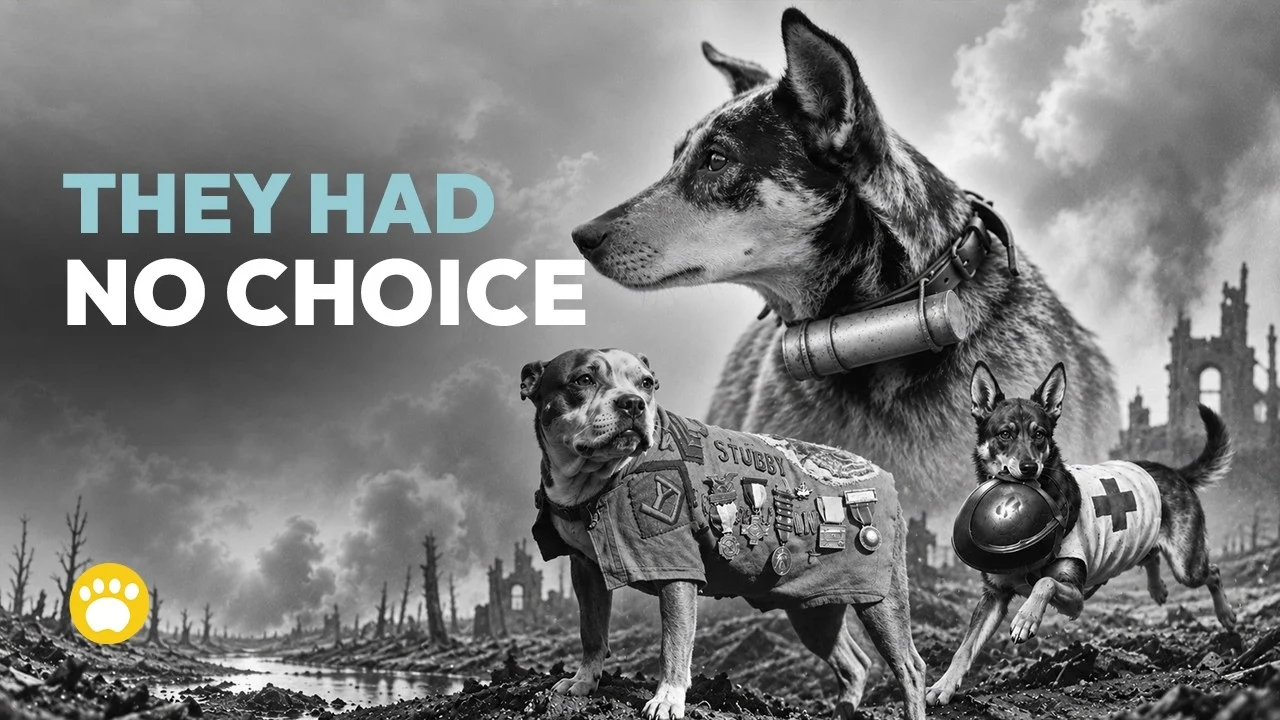
In 1917 a short-tailed brindle stray wandered onto the training grounds of the 102nd Infantry Regiment in New Haven, Connecticut. Private J. Robert Conroy named him Stubby and smuggled him to France inside his overcoat. Stubby went through 17 battles over 18 months and survived a mustard gas attack. Afterward he was so sensitive to gas that during a pre-dawn attack he ran the length of the trench barking and biting sleeping men until they got their masks on. He died on March 16, 1926; his preserved body is at the Smithsonian National Museum of American History.
Armies did issue gas masks to dogs, but a dog wearing one cannot pant and overheats. Mercy dogs couldn’t use them at all, since a covered nose defeats the purpose.
“They had no choice”
Most never came home. There was no demobilization for war dogs in 1918. In London, at Brook Gate on Park Lane, a curved Portland stone wall was unveiled on November 24, 2004. A bronze dog stands past it, head turned back. The inscription reads: They had no choice.