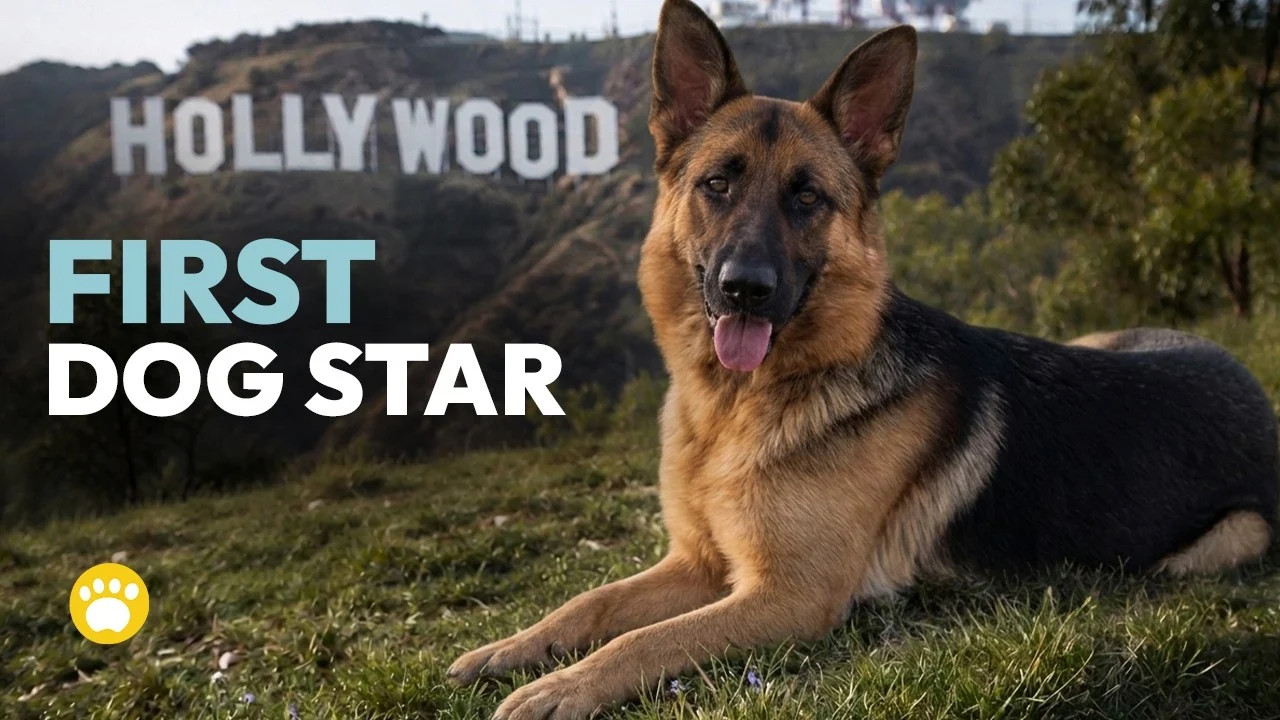
A starving puppy pulled out of a bombed kennel in France went on to out-earn most human actors in Hollywood, keep a major studio out of bankruptcy, and put the German Shepherd in American living rooms for forty years. His name was Rin Tin Tin, and one of the most repeated stories about him is completely false.
Found in a ruined kennel
On September 15, 1918, American forces had just pushed the Germans back at the Battle of Saint-Mihiel. Corporal Lee Duncan of the 135th Aero Squadron was sent to the village of Flirey to scout ground for an airfield. He found a damaged kennel the German army had used to supply military working dogs. Most animals inside were dead. In the wreckage was a starving mother German Shepherd and five newborn puppies, eyes still closed.
Duncan kept one male and one female and named them Rin Tin Tin and Nanette, after small yarn dolls French children gave American soldiers for luck. Duncan had been placed in an orphanage himself in 1898. In July 1919 he smuggled the dogs home; Nanette died of pneumonia on the trip, and a Long Island breeder gave him a replacement he named Nanette II.

From dog shows to the movies
In Los Angeles, Duncan worked at a sporting goods store and trained in his free hours. The dog could clear an eleven-foot fence and follow a scent trail across roughly 700 yards. At a 1922 dog show he won the jumping competition, an inventor named Charles Jones filmed it, and that gave Duncan the idea. The dog got a small role in The Man from Hell’s River that year, standing in for a wolf that wouldn’t cooperate.
The mortgage lifter
Duncan wrote a screenplay built around the dog, and Warner Bros. released Where the North Begins on July 1, 1923. The studio was renting out its own lot just to stay solvent. The picture cost $73,000 to $100,000 and brought in $352,000 to $441,000, pulling Warner Bros. back from collapse. Insiders called the dog “the mortgage lifter.”
Twenty-six more pictures followed. Rin Tin Tin earned about $1,000 a week. The studio kept eighteen trained stand-ins for harder stunts and answered thousands of fan letters with photos signed by paw print.

The Oscar myth
You’ll hear that Rin Tin Tin won the most votes for Best Actor at the first Academy Awards and the Academy quietly recounted so a human would win. It didn’t happen. Warner Bros. executive Darryl Zanuck thought the awards ridiculous and sent the Academy a mocking fake ballot listing the dog. Ballots from that ceremony were signed, not secret, and sit in the Margaret Herrick Library. Former Academy director Bruce Davis examined them: not one names the dog. Emil Jannings won outright.
Sound, and the end
Talkies ended the run; Warner Bros. released Duncan and the dog in 1929. Duncan switched to hand signals so microphones wouldn’t pick him up and kept working with independent producers.
On August 10, 1932, Duncan found the dog on the ground at home, moments from death. He was fourteen. Radio programming was interrupted for a bulletin, and press agents invented versions of the death, including that he died in Jean Harlow’s arms. Duncan buried him in his backyard, then sold the house during the Depression and sent the body to France, where it lies in the pet cemetery at Asnières-sur-Seine.
The legacy
- WWII Rin Tin Tin III helped train 5,000+ dogs and handlers at Camp Haan
- 1954–59 The Adventures of Rin-Tin-Tin, 164 episodes on ABC
- Feb 8, 1960 A star on the Hollywood Walk of Fame, 1627 Vine Street
- Today The name lives on with Rin Tin Tin XII
The takeaway
Duncan died in September 1960, never having trademarked the name. A dog found half-dead in a French kennel turned the German Shepherd into one of the most registered breeds in the country.