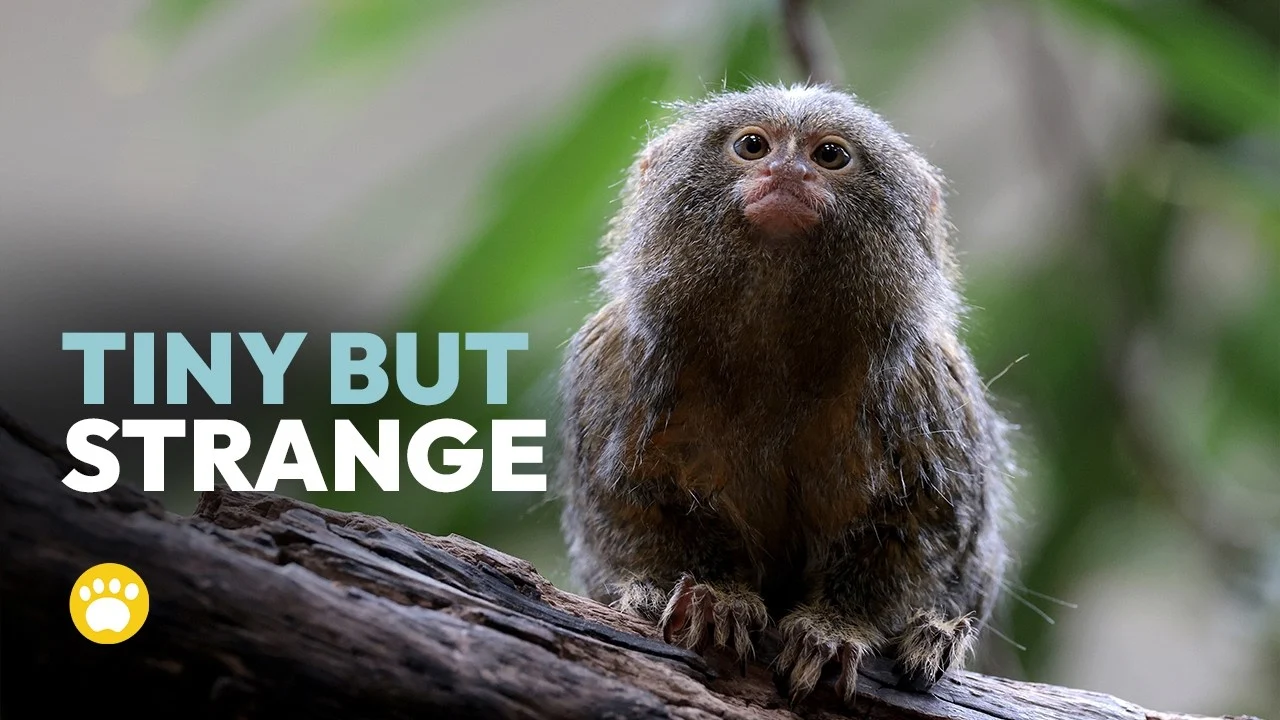
Some marmoset babies are born carrying pieces of their twin inside their own bodies. Not just a shared birthday, but actual cells from their sibling, mixed into their blood. That is only one of the strange things about these tiny monkeys.
There are more than 20 kinds of marmoset in South America, but two get most of the attention: the common marmoset and the pygmy marmoset. They look alike at first glance, but side by side the differences are big.
Side by side
| Common marmoset | Pygmy marmoset | |
|---|---|---|
| Body length | About 6 to 10 in | About 5 to 6 in |
| Tail | 12 to 14 in, banded | Longer than its body |
| Adult weight | Around 9 oz | Around 4 oz |
| Look | Gray-brown, white ear tufts | Tawny orange-brown, mane over ears |
| Home | Northeastern Brazil | Western Amazon rainforest |
The common marmoset
This is the one most people picture: gray-brown fur, a long tail with dark and pale bands, and two big tufts of white fur on the sides of its head. It travels in family groups of 3 to 15 animals. In the wild it usually reaches about 12 years of age, and in good care it can reach 16.

The pygmy marmoset: the smallest monkey in the world
An adult pygmy marmoset weighs around 4 ounces, about the weight of a stick of butter. A newborn is close to the size of a human thumb.
It has two extra tricks. It can turn its head 180 degrees to watch for danger, and it can leap up to 16 feet between branches, more than 30 times its own body length.
A diet of tree gum
Both monkeys survive mainly on tree gum and sap. They use sharp lower teeth to gnaw small holes in bark, then come back to lick up the sticky liquid. They also eat insects, fruit, flowers and sometimes small lizards or bird eggs.
Pygmy marmosets take this further. A group usually feeds from just a few favorite trees and can drill up to 1,300 holes into one of them. Those holes double as a trap: butterflies are drawn to the sap, and the marmosets wait nearby to grab them.
Both species have claw-like nails instead of the flat nails most monkeys have, so they cling to tree trunks the way squirrels do.

The twin mystery
Marmosets almost always give birth to twins, which is unusual for monkeys. Before birth, the twins share a connected blood supply, and cells pass from one to the other. In some male common marmosets, part of the sperm actually comes from the twin brother. That means a baby can inherit genes from its uncle, passed along through its own father.
Dads do the heavy lifting
Common marmoset fathers start carrying their babies the day after birth and can keep it up for more than 3 months. Older siblings help too, while the whole family watches for hawks, snakes and wild cats.
Common marmosets also take turns when calling back and forth, and use specific calls for specific family members, which works a lot like a name. Pygmy marmosets chatter in high voices, and some of their calls are too high for human ears to hear at all.
Why marmosets make poor pets
With all that personality in such a small body, it is easy to see why some people want one. The reality:
- Marmosets were never domesticated. They need their own kind, and one raised alone often becomes stressed or aggressive.
- Without the right food, extra vitamin D3 and real sunlight or special lighting, they often develop a bone disease that leaves bones soft and easily broken.
- They rub scent glands on everything, so a home takes on a strong musky smell.
- The virus that gives people cold sores can kill a marmoset.
Owning one is illegal or restricted in many US states, and for the pygmy marmoset, capture for the pet trade is one of the biggest threats it faces in the wild.
The takeaway
Both monkeys do best where they come from: in family groups high in the trees, carrying each other’s babies and calling each other by name.