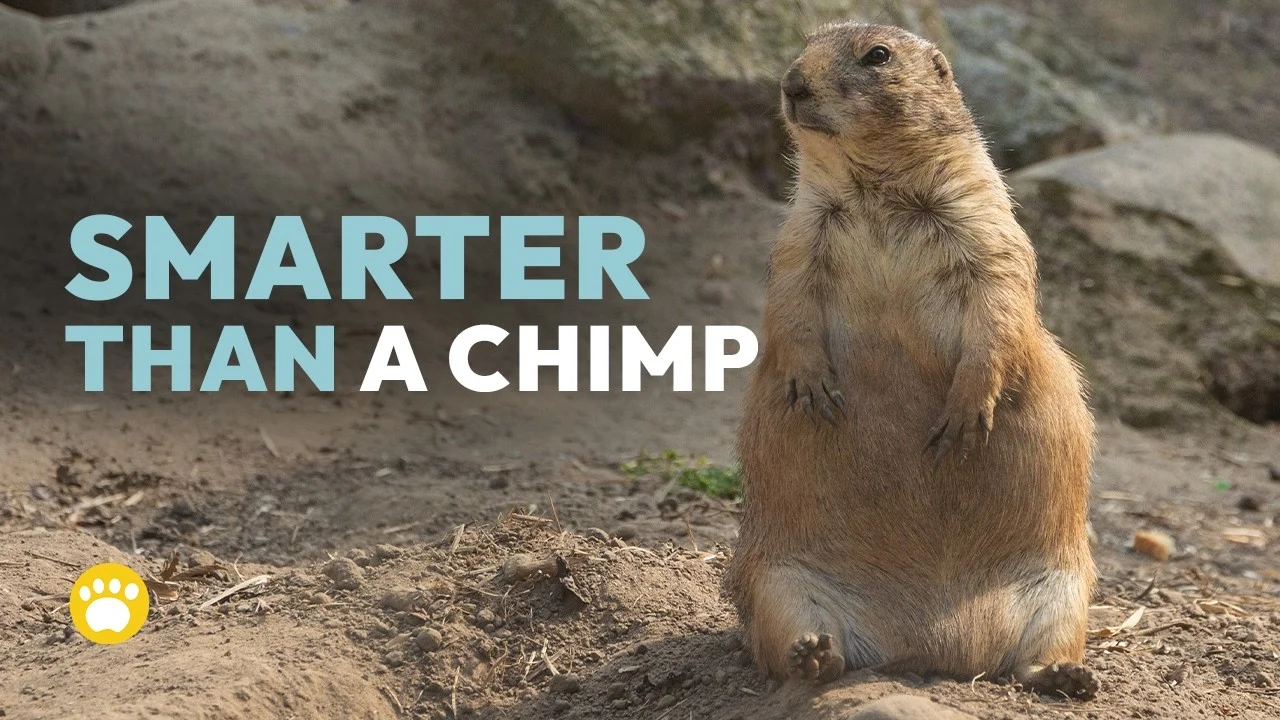
Most people hear “prairie dog” and picture a chubby rodent poking its head out of a hole. That assumption is wrong in almost every way. Prairie dogs aren’t dogs, and they aren’t simple. What they’ve built beneath the Great Plains is one of the most structured, socially rich communities in the animal kingdom.
Prairie dogs at a glance
- Genus Cynomys (“dog-mouse”), a ground squirrel
- Species Black-tailed, white-tailed, Gunnison’s, Utah, Mexican
- Black-tailed size 14 to 17 in; 2 to 3 lb
- Utah prairie dog Fewer than 8,000; threatened
- Historic range left About 2 to 4 percent
Five species, two lifestyles
The name comes from the bark-like alarm call settlers heard across the plains. Black-tailed and Mexican prairie dogs have longer black-tipped tails and don’t hibernate. The other three have shorter white- or gray-tipped tails and stay underground for about four months each winter.
Underground cities
Tunnels slope 3 to 10 feet down, then run horizontally up to 50 feet with branches and rooms for sleeping, nesting and waste. Dedicated toilet chambers reduce disease. Sharply angled tunnels slow snakes and badgers, and a shallow listening chamber below each entrance lets the animal check for danger before emerging.
The cleverest trick is ventilation. Burrows can reach 32 feet, too long for air to refresh by itself. The two entrances are built at different heights and shapes, so wind across them creates a pressure difference: one draws fresh air in while the other pushes stale air out. A typical family territory has about 70 burrow entrances.

Families, wards and towns
Prairie dogs live in family groups called coteries, usually an adult male, one or more adult females and their young. Coteries form wards, and wards form a town. Family members greet with something like a kiss, a brief mouth press that doubles as a scent check. Strangers from other coteries get stares, teeth chattering, tail flaring and sometimes fights lasting more than 30 minutes. A sentinel watches from the mound while others forage. Pups spend six weeks underground before surfacing and are full-grown by five months.
A language that describes you
Biologist Con Slobodchikoff began studying Gunnison’s prairie dogs in Arizona in the mid-1980s and spent more than 30 years on it. His team walked through colonies in different colored shirts, different sizes of clothing and at different speeds, then analyzed the alarm calls. The calls described the color of a person’s clothes, their size and shape, and even whether that person had appeared before carrying a gun.
Prairie dogs have at least 12 calls, including distinct ones for coyotes, domestic dogs, red-tailed hawks and humans, layered with speed, size, shape and color. Slobodchikoff also found evidence for displacement, communicating about things not currently present, once thought nearly unique to human language. Their communication has been described as the most sophisticated animal language yet decoded.
The jump-yip
A black-tailed prairie dog stretches upright, throws its forefeet into the air and calls; its neighbor does the same, then the next, rippling across the colony. It signals a threat just passed or checks the colony’s alertness. If the wave of responses comes back fast and strong, the initiator forages more; if it’s weak, it stays watchful.

Holding the grassland together
- Burrows aerate soil and improve water absorption; droppings fertilize it.
- Selective grazing keeps any one plant from dominating, so colony vegetation is often more nutritious, which draws bison and pronghorn. Bison graze tall grass, creating the short grass prairie dogs prefer.
- Over 150 species benefit, from burrowing owls and swift foxes to tiger salamanders.
- Black-footed ferrets eat prairie dogs for 90 percent of their diet and raise young in their burrows. Without prairie dogs, they can’t exist.
From 5 billion to a fraction
The largest town ever recorded, in early-1900s Texas, covered 25,000 square miles and held 400 million animals. Before 1800, the total population was estimated at 5 billion. Then came federal poisoning campaigns from 1918 targeting them as livestock competitors, and sylvatic plague, arriving on ship-borne fleas around 1900, to which they had no immunity. More than 95 percent of black-tailed prairie dogs are gone.
Recovery work is real. A USGS-trialed oral plague vaccine in peanut-butter-flavored bait was eaten by about 70 percent of wild prairie dogs, with higher survival on vaccinated plots. Conservation groups relocate animals and hand-dig starter burrows for new colonies.
Next time you drive the Great Plains
Stop the car, watch a colony for a few minutes, and listen. What you’re hearing is far older and more complex than it looks.