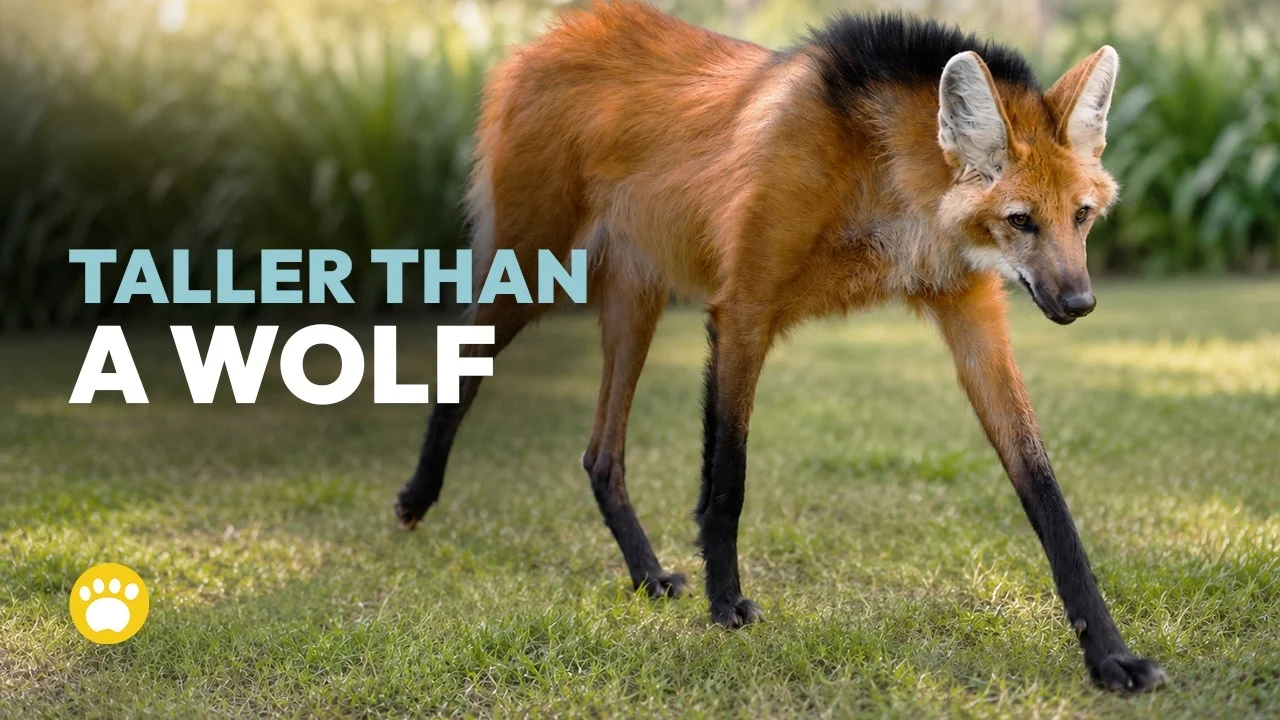
There’s an animal in Brazil that stands taller at the shoulder than a gray wolf, weighs about as much as a Labrador, has ears like a bat, walks like a camel and eats tomato relatives. It’s called a wolf. It isn’t one. It isn’t a fox either, despite looking like someone stretched a red fox onto stilts. This is the maned wolf, and almost nothing about it works the way you’d expect from the dog family.
Maned wolf at a glance
- Height About 3 feet at the shoulder
- Weight 44 to 66 pounds
- Diet 40 to 90 percent plants
- Territory About 10 to 12 square miles per pair
- Population About 17,000 adults; Near Threatened
Legs built for periscoping
Those legs aren’t built for chasing. The maned wolf lives in the Cerrado, central Brazil’s vast savanna, where grass grows high enough to swallow a normal dog. The legs lift its head above the grass line, and ears up to seven inches tall rotate like dishes to catch a rodent moving through the stems. It even paces, moving the front and back legs on the same side together, like camels and giraffes.
A family of one
The maned wolf is the only living species in its genus, Chrysocyon, Greek for “golden dog.” Its nearest known relative was the Falkland Islands wolf, which Charles Darwin puzzled over on the Beagle voyage in 1834 and which went extinct in the 19th century. DNA work published in 2009 found the two lineages split about 6.7 million years ago.

The wolf apple
One plant dominates its diet: the lobeira, or wolf apple, a nightshade related to tomatoes that grows across the Cerrado. A ripe fruit can weigh over a pound, and the plant is literally named after the animal.
How it hunts
It hunts alone. It rotates those ears to locate a rustle, creeps forward, then taps the ground with a front paw to startle whatever is hiding. When the animal breaks cover, the maned wolf launches straight up and comes down on it with both front feet, the way a serval does.

The cannabis smell
Maned wolf urine has an odor people consistently describe as cannabis. In 2006, police were called to the Rotterdam Zoo after a visitor reported someone smoking marijuana. There was no smoker; the smell came from the maned wolf enclosure. The compounds responsible are pyrazines, which work as long-lasting scent signals.
Gardening with leafcutter ants
Maned wolves leave droppings on leafcutter ant mounds. The ants haul the dung down to fertilize their fungus gardens, then discard the seeds onto refuse piles outside the nest, where they germinate at far higher rates. A fruit that heavy needs a large disperser, and the Cerrado has no elephants. The maned wolf does the planting.
A strange kind of marriage
Pairs are monogamous and share a territory, but they don’t hunt or travel together. They communicate at a distance through scent and a low, hoarse roar-bark that carries across open country.
On the money
More than 90 percent of maned wolves live in Brazil, where habitat loss to soy and cattle, and road deaths, drive their decline. Brazil put it on the 200-real banknote in August 2020: its highest denomination features a fruit-eating loner nobody outside South America can correctly classify.