Ask most people how old the Boerboel is and you’ll hear numbers like 350 years. The breed is sold as an ancient African guardian. Here is what rarely makes the pitch: no stud book exists for the Boerboel before the 1970s. The earliest birth years in its recorded pedigree reach back only to about 1971. The dog you can buy today was deliberately rebuilt in the early 1980s from a scattered group of surviving farm dogs.
Farmer’s mastiff
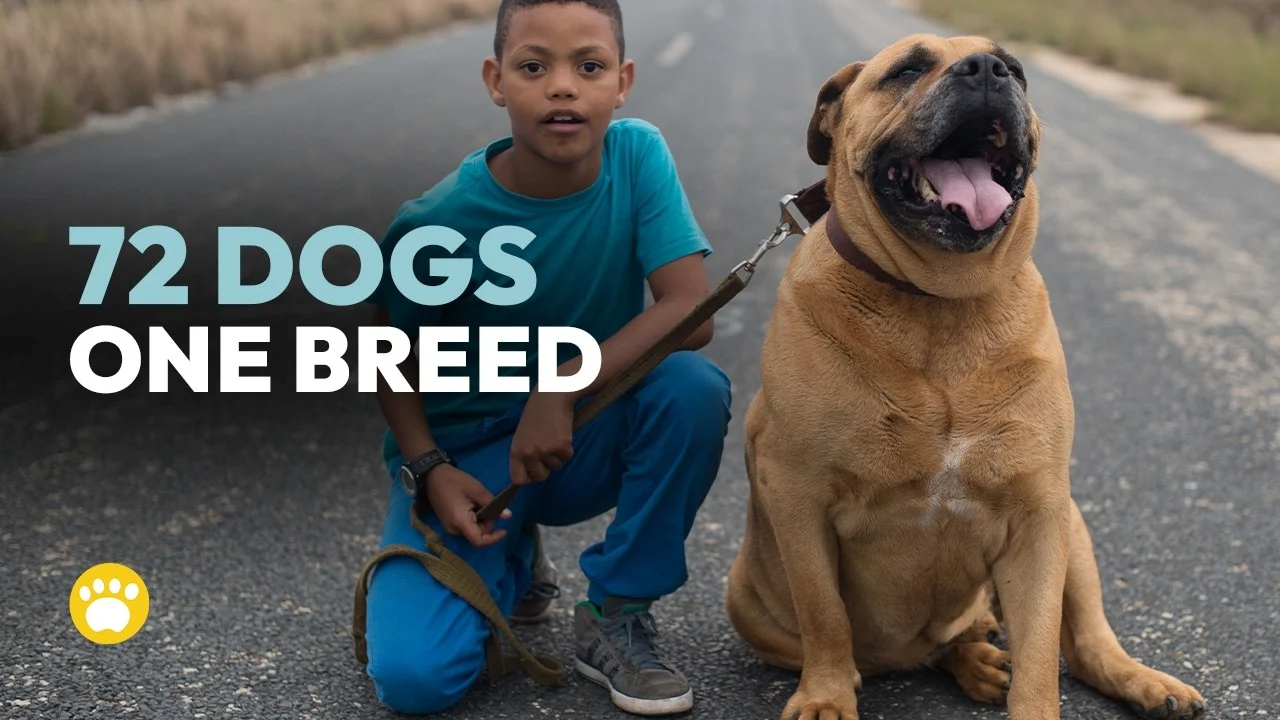
Boer is Afrikaans for farmer. Boel most likely shortens boelhond, bulldog or large mastiff. Not a show dog, a homestead guardian.

Where it really comes from
The thread starts in 1652, when Jan van Riebeeck arrived at the Cape of Good Hope with a Bullenbijter, a heavy mastiff type now extinct. Settlers brought their own large dogs from the Netherlands, Germany and France, and those bred with southern Africa’s indigenous landrace dogs. Nobody recorded pedigrees. Instead there was a filter: remote farms had no vets and no fences, and dogs that couldn’t handle the heat, distance and predators didn’t leave offspring.
Not a lion fighter
You’ll read that the Boerboel was bred to fight lions. That reputation belongs to the lighter Rhodesian Ridgeback line, and even those dogs held lions at bay for an armed hunter. The documented predator work was leopards, baboons, jackals and hyenas, done in packs with an armed person present. A 1909 article, “The Boer Hunting Dog,” in the Agricultural Journal of the Cape of Good Hope described a mastiff-bulldog cross as the best dog for going after leopards and baboons.
Two events that reshaped it
- The Great Trek, from the mid-1830s, carried farm dogs deep into the interior onto isolated homesteads.
- British settlement pushed English mastiffs and bulldogs into the same gene pool. Bullmastiffs really did guard the De Beers mines at Kimberley, most likely in the 1930s; a De Beers Bullmastiff named Springwell Major was registered in 1935. You can see it in the blocky head, heavy bone, and fawn, red and brindle coats.
Near disappearance and the rebuild
Farms mechanized, families moved to cities, and surviving dogs were crossed with whatever was around. What vanished was not the farm dog but consistency.
In August 1980, a small group of breeders traveled across South Africa looking for dogs still true to type. They assessed roughly 250 animals and selected 72 for a foundation register. The South African Boerboel Breeders Association was founded in 1983 under chairman Johan de Jager, and the first written standard followed in 1987.

The genetic cost
In March 2024, Mabunda and colleagues published a pedigree analysis of 87,755 studbook records for dogs born 1971 to 2019. More than 91 percent were inbred to some degree. Only ten ancestors accounted for over half the breed’s genetic diversity, and the effective population size came out around 83.
What they bred out
A dog that couldn’t tell a neighbor from a thief was useless, and one that turned on the family was worse. Temperament was the qualifying trait, not size. Breeding dogs still face a formal appraisal covering 43 points, and a dog scoring below 75 percent is denied breeding rights.
The takeaway
The AKC granted full recognition on January 1, 2015. In South Africa the breed is protected as an indigenous landrace under the Animal Improvement Act of 1998, so Boerboels can only leave the country with a permit. A nation that nearly let the type disappear now controls who may take one out.