There’s an animal on the plains of southern Africa that can go its entire life without drinking a drop of water. It can outrun almost everything chasing it. And not long ago it moved in herds so enormous that one eyewitness counted half a million in a single glance and still couldn’t see where the herd ended. If you only know the springbok from a rugby team, you’ve been underestimating it.
Springbok at a glance
- Scientific name Antidorcas marsupialis
- Height / weight About 31 in; 60 to 105 lb
- Top speed About 55 mph in bursts
- Range Namibia, Botswana, South Africa, parts of Angola
- Population 2 to 2.5 million, and growing
Built for open plains
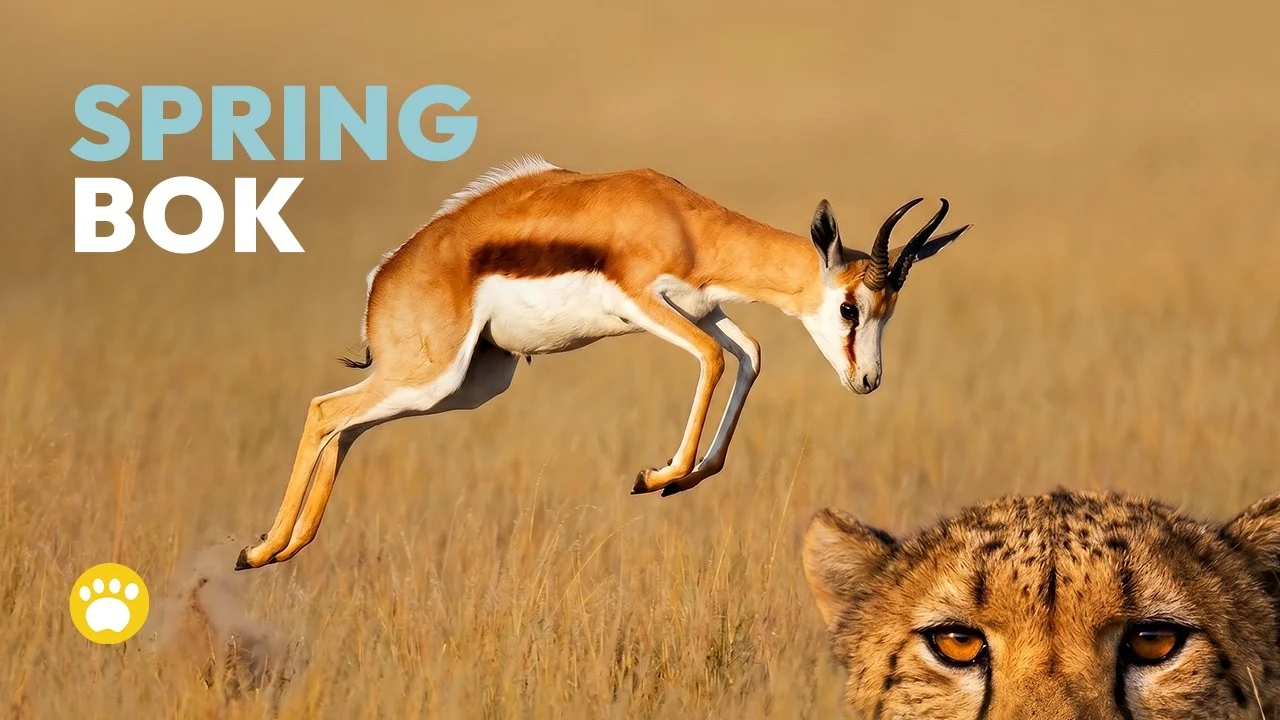
A cinnamon-brown back is separated from a white belly by a bold chocolate stripe, and a dark line runs from each eye to the mouth. Both sexes carry lyre-shaped horns up to 20 inches long; older males’ horns are worn and chipped, each chip a record of a battle survived. Springbok thrive in Etosha National Park, across the Kalahari and through the dry Karoo.
Living without drinking
The Kalahari gets less than 20 inches of rain a year, surface water vanishes for months, and temperatures swing from 113°F by day to near freezing at night. A 1994 study in the Journal of Mammalogy found springbok that never reached surface water in the dry season still kept their water balance, as long as their plants contained at least 67 percent water.
- They graze before dawn, when plants are at their most succulent.
- They face away from the sun, using the white rump to reflect heat.
- A network of blood vessels in the head cools blood before it reaches the brain.

Speed and agility
Raw speed isn’t the whole story: springbok can cut and twist at high speed, breaking a predator’s momentum. Their leg muscles are about 58 percent fast-twitch fibers, and a key anaerobic enzyme works at four times the rate in human muscle. Cheetahs are the main hunter, and lions, leopards, spotted hyenas, African wild dogs and caracals all take springbok. In Etosha during the early-1980s droughts, lions shifted from 80 percent wildebeest and zebra to 62 percent springbok, and when drought cut springbok numbers, lion numbers followed. That makes the springbok a keystone prey species.
Pronking: the leap nobody fully understands
At seemingly random moments, a springbok launches straight up, legs rigid, back arched, head down, bouncing as high as 10 feet while barely moving forward. It’s called pronking, from the Afrikaans for “to show off.” As it pronks, a pocket of skin along the back opens to reveal a fan of white hair and releases a honey-like scent.
- Fitness signal: the best-supported idea. An animal spending that much energy is telling predators it’s too costly to chase, and predators do appear to target non-pronking individuals.
- Confusion: dozens leaping in different directions disrupt a predator’s lock on one target.
- Orientation: from 10 feet up, a springbok can see over tall grass.
- Play: springbok sometimes pronk with no predator around, on mornings when food is plentiful.

Territory and the herd
Dominant males hold territories of 25 to 175 acres, marked with dung, urine and horned vegetation. Their hooked horns can lock together in fights, and sometimes both males die entangled. Only territory holders breed. In mixed herds, animals on the edges spend about twice as long scanning for threats as those in the middle, so the bigger the herd, the less each animal must watch.
The lost migrations
In the late 1800s, drought triggered migrations called trekbokken. In 1896, Cronwright-Schreiner and two farmers near Prieska estimated about half a million springbok in their line of sight, in a migration covering an area 140 miles long and 15 miles wide. Witnesses described herds taking three days to pass through a town, the ground shaking beneath an unbroken front miles across. Gardens were stripped to bare dirt.
By 1897, barbed wire, farming and hunting had broken the herds. The last great trek passed through the Northern Cape in 1896 and was never seen again, ending before anyone studied it scientifically.
The takeaway
The great migrations exist only in written accounts now. But the springbok is still here, grazing the Kalahari before dawn, drinking nothing, and still launching into that stiff-legged leap that means something to the herd and something we haven’t fully figured out.