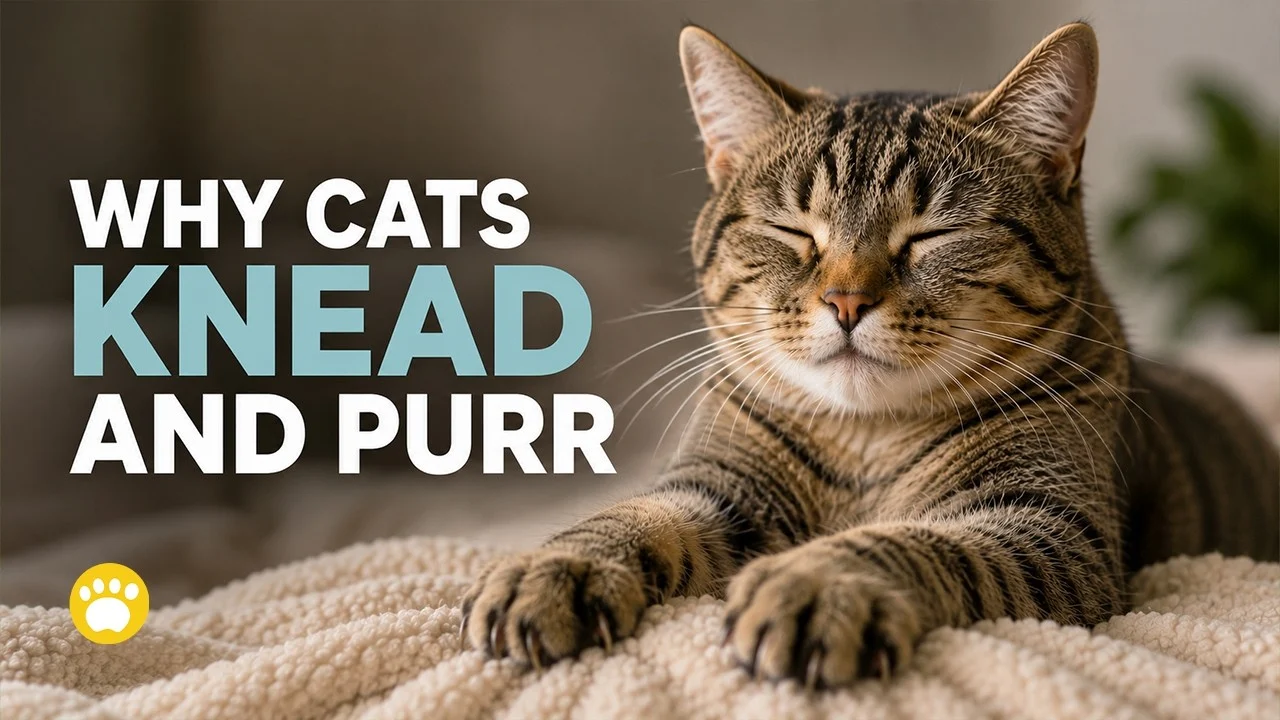
Your cat climbs onto your chest, plants both front paws and starts pushing. Claws maybe out, maybe not. Eyes half closed. And somewhere under the fur, an engine kicks on. Every piece of that routine traces back to something specific, and part of what scientists thought they knew got overturned in 2023.
Kneading starts at the milk bar
Kittens are born blind and deaf, with about two weeks before either sense comes online. What they can do is feel vibration and push. A nursing newborn presses its front paws into the mammary gland on either side of the nipple. Vets call it the milk tread, and the pressure stimulates milk letdown.

Why adult cats still do it
The answer runs through domestication. Wildcats moved in on human grain stores in the Fertile Crescent roughly 10,000 to 12,000 years ago, drawn by rodents. Nobody rounded them up; they selected themselves into the arrangement. John Bradshaw at the University of Bristol describes adult cat social behavior as derived from kitten behavior.
Free-living cats never socialized to people largely drop kneading, meowing and purring toward other adults once they leave the nest. House cats never fully leave the nest: you feed them, keep them warm and let them climb on you. Kristyn Vitale, whose 2019 work found about 65 percent of cats form secure attachments with their owners, suggests behavior once aimed at the mother now gets pointed at the person.
Kneading is also labeling you
Cats carry glands in their paw pads that release a chemical signal researchers call the feline interdigital semiochemical. Every time the toes spread, some goes onto whatever is underneath. When your cat kneads your leg, you’re being marked as familiar territory.
There’s an older function too. Wild cats tamp down grass before lying down to flatten it and check what’s underneath, and a blanket gets the same treatment.
Wool sucking
When kneading tips into suckling on fabric, that links to weaning. A Finnish survey of over 5,000 house cats found those separated from their mother before twelve weeks showed more wool sucking and more aggression. It only warrants a vet call if the cat starts swallowing the material.
How purring works: the 2023 surprise
For half a century, the consensus was that purring needed constant instruction from the brain, firing the laryngeal muscles 20 to 30 times a second. In 2023, Christian Herbst and colleagues at the University of Vienna tested eight excised cat larynges. With no brain attached and no muscle contraction possible, all eight still produced self-sustaining vibration at 25 to 30 hertz. Connective tissue pads in the vocal folds appear to let a nine-pound animal hit frequencies far below any human bass voice. Not everyone is convinced a removed larynx behaves like a living one, and the answer probably involves both.

The hidden cry in a food purr
Karen McComb at the University of Sussex compared cats purring for food with ordinary purrs. Buried inside the food purr was a high-frequency component around 380 hertz, close to a human infant cry. Listeners rated those purrs as more urgent and less pleasant, even people who had never owned a cat. Strip that component out and the urgency drops.
Does purring heal?
Cats also purr when frightened, injured, in labor or dying. Bioacoustics researcher Elizabeth von Muggenthaler recorded 44 cats across several species and found strong frequencies between 25 and 150 hertz, a band that overlaps with vibration research on bone density and fracture repair. The overlap is real, but the causal claim is unproven, and no veterinary source treats purring as treatment.
What purring really tells you
Purring reports arousal, not mood. A cat kneading your lap with soft eyes and a loose body is comfortable. A cat purring in a carrier with a tense body, flat ears or open-mouth breathing is coping, and needs an exam rather than reassurance.