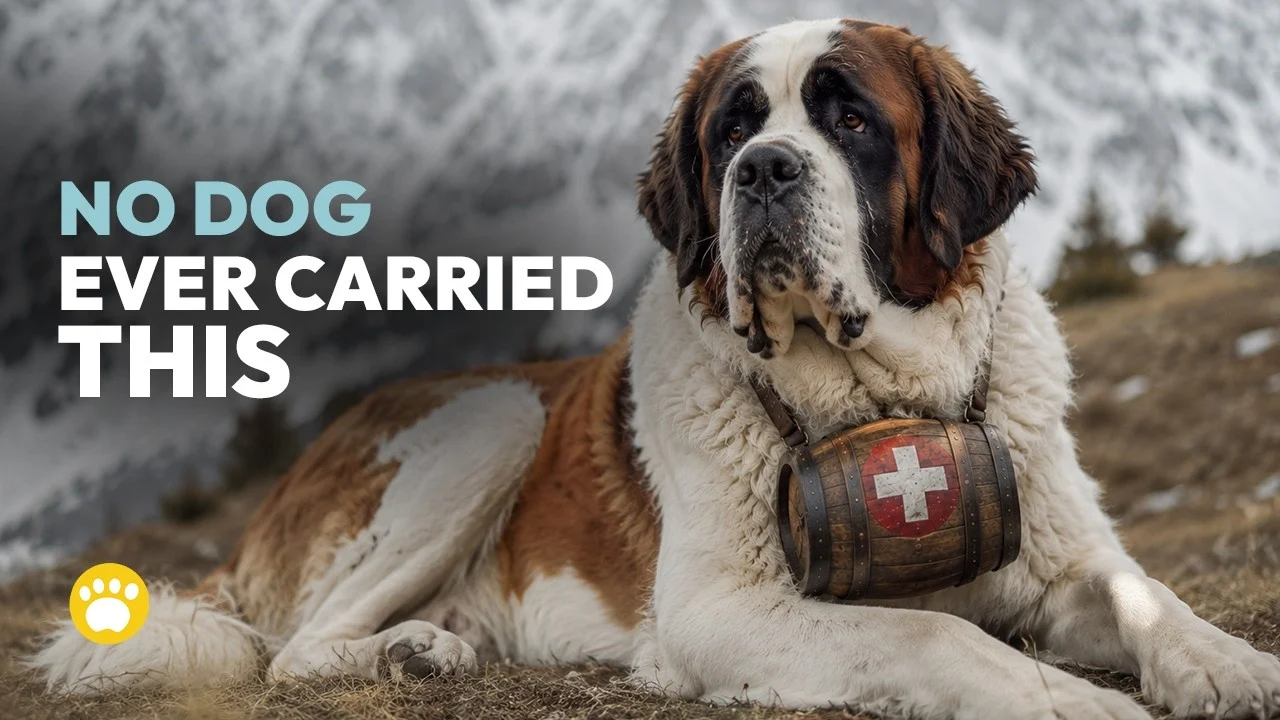
A St. Bernard named Benedictine v. Schwarzwald Hof made the 1981 Guinness Book of World Records at 315 pounds. Most people know this breed from a movie or a cartoon barrel, and almost everything they think they know is exaggerated or flat-out wrong.
St. Bernard at a glance
- Males 28 to 30 in, 140 to 180 lb
- Females 26 to 28 in, 120 to 140 lb
- Coat Dense double coat (short or long)
- Average lifespan 9.3 years (2024 UK study)
- Key emergency Bloat
The hospice came first, the dogs much later
Around the year 1050, an archdeacon of Aosta named Bernard of Menthon founded a hospice atop a brutal Alpine pass between what is now Switzerland and Italy, where travelers heading to Rome were dying. Monks brought large farm dogs up from the valleys sometime between 1660 and 1670, originally as watchdogs, not rescuers. The earliest hospice entry mentioning a dog, from 1707, says in full that a dog was buried by the monks.
How the rescues really worked
By 1750, the servants escorting travelers across the pass brought dogs along because their broad chests plowed a path through deep snow. Then they noticed the dogs could smell a buried person through many feet of snow. So they sent dogs out in groups of two or three, with no handler at all. The dogs would find the traveler, dig, and lie against the body for warmth while another dog ran back for help.
Over roughly two centuries, the hospice dogs are credited with saving around 2,000 lives, including soldiers from Napoleon’s army. The most famous, Barry, worked the pass from 1800 to 1812 and is credited with more than 40 rescues. He died in 1814; his preserved body is on display at the Natural History Museum in Bern. He weighed 88 to 99 pounds, far smaller than a modern St. Bernard.
The brandy barrel is a myth
No hospice dog ever carried brandy. The image comes from a single oil painting finished in 1820 by Edwin Landseer, an English artist who was still a teenager and had never been to the Alps. He hung a small cask on one dog’s collar as a decorative flourish, prints spread across Europe, and a made-up detail became the breed’s trademark. Medically it would have been a terrible idea anyway: alcohol speeds heat loss in a hypothermic person.
The end of the working era
The last recorded Alpine rescue by a St. Bernard was in 1955. Helicopters took over, and the dogs were too heavy to fly. The hospice kept its dogs until 2004, when the Barry Foundation took over the breeding program and moved the kennels down to Martigny. Once dog shows took over, breeders selected for massive heads and heavy bone, which is why the modern dog is far larger than the working dog ever was.
Temperament and the socialization trap
Calm, patient, low prey drive and tolerant of children: that’s why people fall in love. But the reputation leads owners to skip socialization. The window closes around 16 weeks, and correcting a 150-pound adult is a completely different job from guiding a 20-pound puppy.
Health: the hard part
Bloat (gastric dilatation-volvulus) is the emergency to understand: the stomach fills with gas and twists, and the dog has minutes to hours. Watch for retching with nothing coming up, a swollen belly, restlessness, pale gums and collapse. Many vets recommend a preventive gastropexy during spay or neuter surgery.
Also watch for hip and elbow dysplasia, entropion, dilated cardiomyopathy and bone cancer. A 2024 UK study put average lifespan at 9.3 years, against 12.7 for purebred dogs overall.
Puppy and summer care
- Feed large-breed formula with controlled calcium, split into three meals a day.
- No forced running or jumping until growth plates close around 18 months.
- Never shave the coat; the double layer insulates against heat as well as cold.
- This dog overheats fast, so exercise in early morning or evening in warm months.
Thinking about one?
Contact a regional St. Bernard rescue and meet an adult dog in person. Standing next to a full-grown St. Bernard tells you more than any amount of reading.