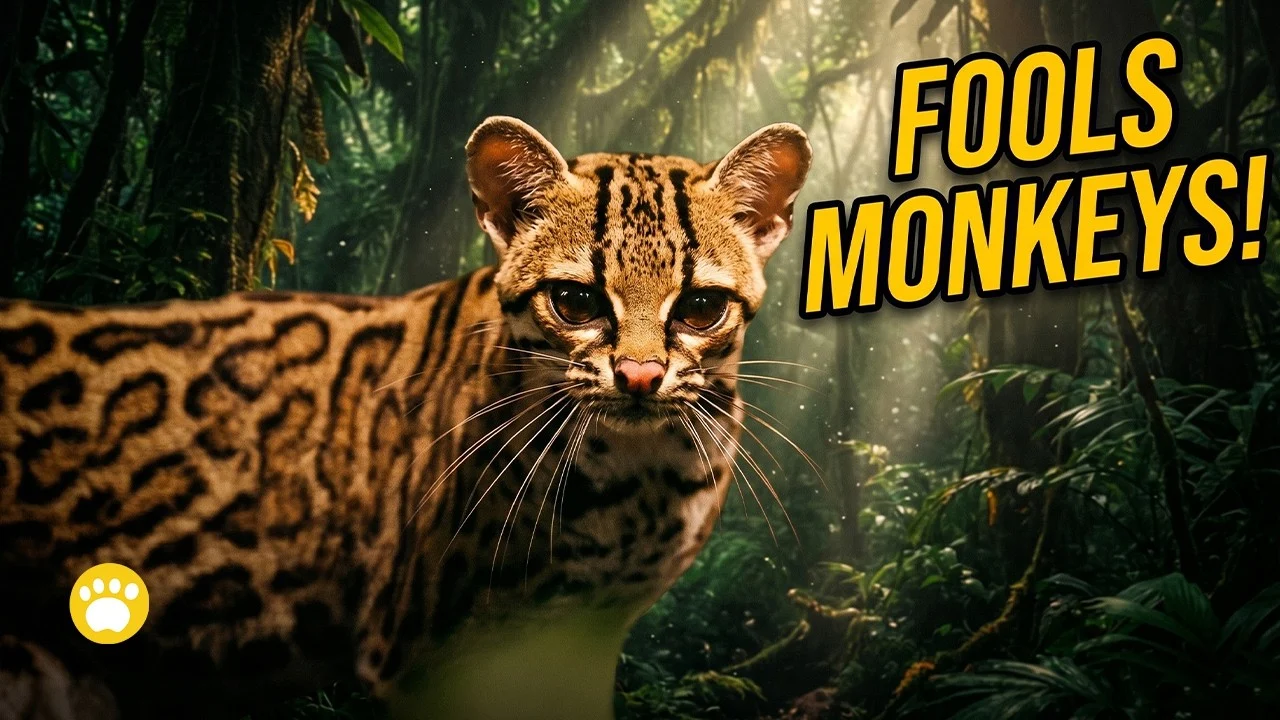
In the Brazilian Amazon in 2005, researchers watching a family of eight tamarins feeding in a fig tree heard the cry of a baby tamarin, small and distressed, coming from a tangle of vines. The sentinel monkey climbed down to investigate, and four others followed. Then the thing making the sound stepped out of the foliage. It wasn’t a lost infant. It was a small spotted cat, coming down the trunk headfirst like a squirrel. The tamarins scattered just in time.
It was the first scientifically documented case of a wild cat in the Americas using vocal mimicry to hunt. Most people have never heard of the animal that pulled it off.
Margay at a glance
- Scientific name Leopardus wiedii
- Weight 5 to 9 pounds
- Range Southern Mexico to northern Argentina
- Home range 4.2 to 6.2 square miles
- Status Near Threatened
Not a baby ocelot
The margay lives in dense tropical forest from southern Mexico through Central America into Brazil, Paraguay and northern Argentina. It’s roughly the size of a large house cat, with a tawny coat of dark-ringed rosettes. Most people seeing a photo assume it’s a young ocelot. The differences, once you know them, are striking.
Ankles that turn backward
The margay’s hind ankles rotate up to 180 degrees outward, so it can grip a trunk as well going down as going up, walk headfirst down a vertical surface, and hang from a single hind foot. The only other cat that shares this ability is the clouded leopard. It’s been recorded leaping nearly 12 feet between branches.
Eyes and tail
Its large, round amber-brown eyes take up more of its face than any comparable wild cat’s, pulling in detail on dark canopy nights. Its tail, up to 70 percent of its body length, works as a counterweight during sudden mid-leap turns.
The monkey-call hunt
The tamarin incident was documented by the Wildlife Conservation Society in the Reserva Florestal Adolpho Ducke near Manaus. The margay, hidden in lianas, produced calls closely resembling a tamarin pup in distress. The sentinel recognized the deception, screamed an alarm, and the group fled. Researcher Fabio Rohe called it evidence of psychological cunning in a species known mainly for agility. Indigenous Amazonian communities said they had seen the behavior before; it just hadn’t been caught on record.
Its diet includes birds, small mammals, reptiles, tree frogs and occasionally small monkeys.
Why it’s so vulnerable
- It lives alone and almost never crosses open ground. Where forest is fragmented, margays disappear.
- Where ocelots are dense, margays shrink further, outcompeted and sometimes preyed on.
- Females have a single kitten roughly once every two years, about five offspring in a lifetime, one of the lowest rates of any small cat.
- At least 125,000 margay skins were traded internationally between the mid-1970s and mid-1980s. Trade was banned with a CITES Appendix I listing in 1989, but deforestation, road deaths and the illegal pet trade continue.
A living measure of the forest
When you find a margay, you’ve found a place where the rainforest is still genuinely intact. When you stop finding them, you haven’t just lost a spotted cat. You’ve lost the thing the cat was measuring.