Somewhere in the forests of Asia lives a cat that weighs about as much as a medium-sized dog, yet carries upper fangs close to 2 inches long. That is roughly the length of a tiger’s canines, on an animal about ten times smaller. It can run headfirst down a tree trunk like a squirrel and hang from a branch by its back feet.
And when two adults of this species meet, one of the biggest dangers they face is each other. Here is everything that makes the clouded leopard one of the strangest cats alive.
Clouded leopard at a glance
- Weight 25 to 51 pounds; males can be twice the size of females
- Tail Up to 3 feet, nearly as long as the body
- Range Himalayan foothills through Southeast Asia, plus Borneo and Sumatra
- Home range Roughly 12 to 15 square miles per adult
- Status Both species listed as vulnerable
It is not actually a leopard
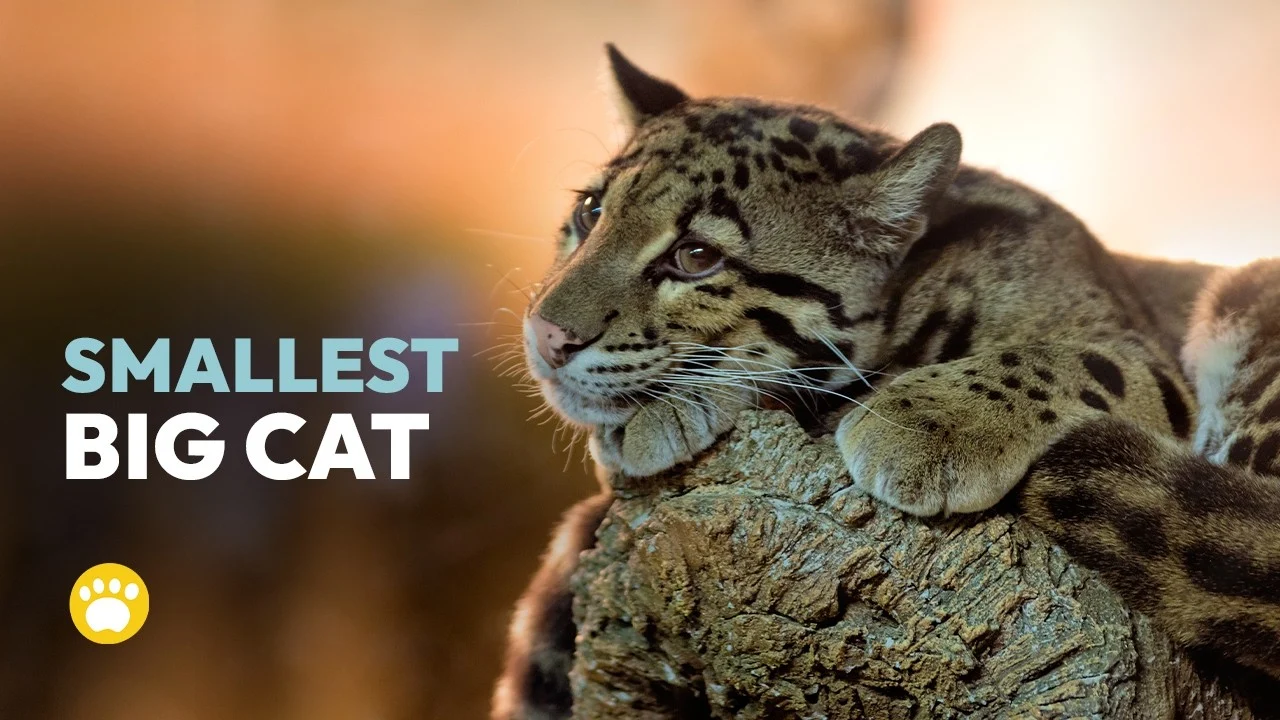
The name is misleading. A clouded leopard is not a leopard at all. It belongs to its own group of cats, separate from lions, tigers, leopards and jaguars. The name comes from its coat, which is covered in large, dark-edged blotches shaped like clouds. In Malaysia, people call it the tree tiger.
The body is long and low, with short, thick legs and wide paws. That long tail works as a counterweight when the cat moves along narrow branches.
The secret is in the ankles
The real reason this cat moves so well in the trees is its back ankles, which rotate much further than most other cats’ ankles can. That one feature unlocks three tricks very few cats on Earth can pull off:
- Climbing down a tree headfirst, gripping the bark with its rear claws pointed backward.
- Crawling upside down along the underside of a branch.
- Hanging by its hind feet while its front paws stay free to grab prey.

The longest fangs of any living cat
Compared with the size of its skull, the clouded leopard has the longest canine teeth of any living cat. Its skull shape has been compared to early saber-toothed cats, and by some estimates its jaws can open close to 100 degrees.
Despite all that climbing skill, it does much of its hunting on the ground. Its menu includes small deer, wild pigs, monkeys, birds and even porcupines. Instead of going for the throat like many cats, it often bites the back of the neck. Long fangs and a wide jaw make that bite deep and fast, which matters when the prey is close to the cat’s own size.
Can it roar? Even zoos disagree
Ask what sound a clouded leopard makes and you will get different answers, even from zoos. Some say it can purr but cannot roar. Others say it can do neither, because its throat bones sit somewhere between the setup of big cats and small cats.
The sound keepers do hear is a chuff: a soft, breathy snort through the nose that works as a friendly greeting. Tigers use it too.

Two species, not one
There are actually two kinds of clouded leopard:
- The mainland clouded leopard lives from the Himalayan foothills through Southeast Asia.
- The Sunda clouded leopard lives only on Borneo and Sumatra. It is darker, has smaller cloud markings, and its canines are even longer.
Both are solitary. Each adult patrols its own patch of forest and is most active around dawn, dusk and at night.
Why meeting a mate can be deadly
This is the part that surprises most people. When an adult male and an adult female are introduced for the first time, the male often attacks the female. Because he can be twice her size, those attacks are frequently deadly, sometimes within moments.
Caretakers found that the one thing that reliably prevents it is age. Males and females introduced as cubs, sometimes as early as six to eight weeks old, grow up together and bond. Pairs that miss that window rarely accept a partner later in life.
Cubs are born weighing around 6 ounces each, with their eyes closed. Their eyes open at about two weeks, and they stay with their mother until they are roughly nine to ten months old.
A cat that is hard to count
The forests clouded leopards depend on are being cleared for farms, logging and palm oil plantations. The cats are also caught in wire snares and hunted for their skin, teeth and bones. The mainland species is estimated at only a few thousand mature adults.
The takeaway
Because it hides so well in the canopy, no one can say exactly how many clouded leopards are left. A cat built this perfectly for the trees is only as safe as the trees themselves.