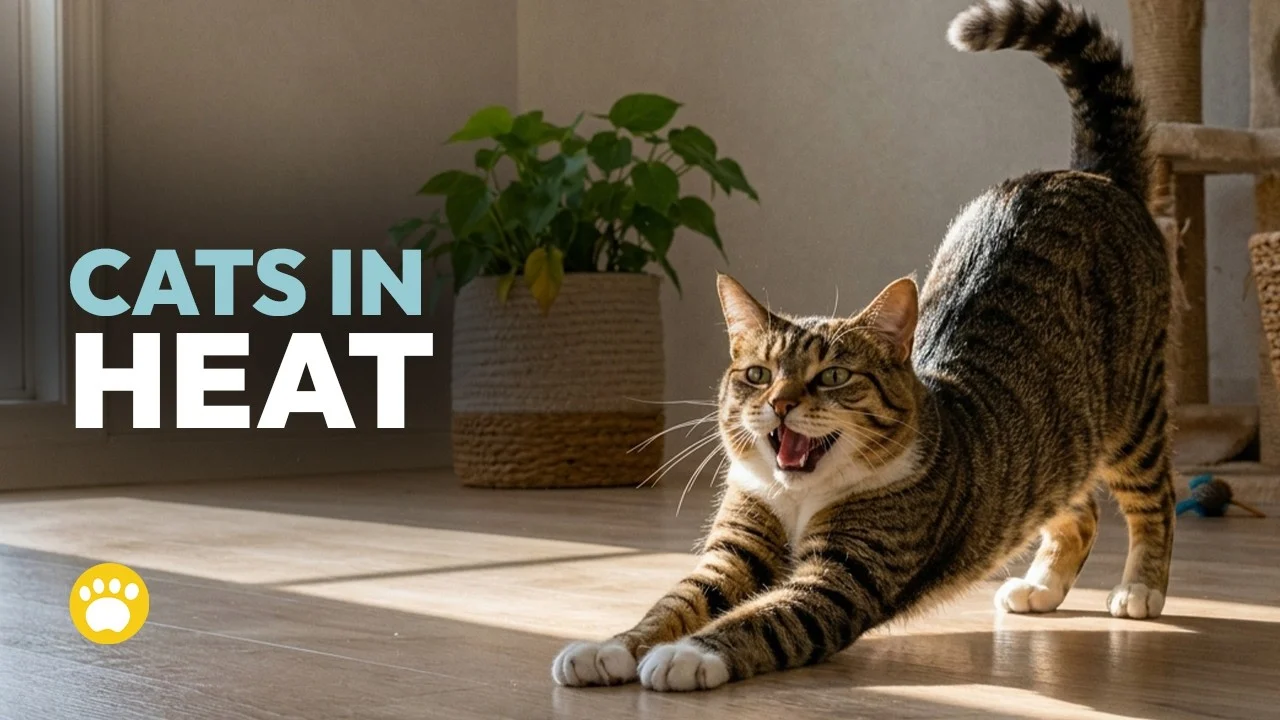
Somewhere around three in the morning, a sound starts. It is low, drawn out, and it repeats for hours. If you’ve never heard a cat in heat, your first thought is that she’s hurt. Most owners start searching for emergency clinics. She isn’t in pain, she isn’t sick, and nothing is broken.
Cat heat cycle at a glance
- First heat Usually 5 to 9 months (some at 3 to 4)
- Length About 7 days (range 1 to 21)
- Break About a week, then it repeats
- Peak season February to April
- Spay by 5 months, per the Feline Sterilization Task Force
What heat actually is
Heat is the common name for estrus, the fertile phase of a female cat’s cycle. An unspayed female is called a queen. Rising estrogen makes her receptive to mating and drives every behavior you’ll see. Cats don’t bleed during heat the way dogs do, with no visible discharge, which is exactly why owners misread it as illness.
Earlier than you think
Most cats have their first heat between five and nine months, but some kittens start at three to four months, while Persians and Maine Coons can wait until ten to eighteen months. Puberty is tied to body condition more than age: a queen usually starts cycling at about 80 percent of adult weight, around five to seven pounds. A kitten who still acts like a baby can be fully fertile.
Why it feels like a month of noise
If she doesn’t mate, she enters a short break called interestrus, usually a week, then cycles again. And again. Cats are long-day breeders: increasing daylight in January and February switches the system on, and most queens go quiet from mid-October through December. Cats kept under 12 to 14 hours of artificial light will cycle year-round.
The signs
- Loud, repetitive yowling, worst at night
- Pacing, and a sharp increase in affection and rubbing
- Rolling on the floor and treading with the back feet
- Raising the hindquarters when you touch her lower back (lordosis)
- Spraying urine with pheromones
- The most dangerous: trying hard to get out the door
The biology that makes cats unusual
Cats are induced ovulators: mating, not a schedule, triggers egg release. The tomcat’s penis has small backward-facing spines that stimulate the vaginal wall on withdrawal, signaling the brain to start ovulation one to three days later. That’s also why the female screams during mating. Because she needs multiple matings to ovulate reliably and accepts several males, one litter can have more than one father, which is why littermates sometimes look unrelated.
Male cats don’t go into heat. An intact tom is fertile year-round; his yowling and spraying are reactions to a female’s pheromones.
Why spaying matters
- Gestation is 63 to 65 days, litters average four to six kittens, and a queen can return to heat while nursing, up to three litters a year.
- Spaying before six months cuts mammary cancer risk by roughly 91 percent, and more than 85 percent of feline mammary tumors are malignant.
- It eliminates pyometra, a uterine infection that needs emergency surgery ($1,200 to $2,200) and is fatal untreated. A routine spay costs $50 to $150 at a low-cost clinic or $300 to $500 at a private hospital.
If she’s cycling right now
You can’t stop it at home. Keep her securely indoors and away from intact males. Give her a quiet room, a clean litter box and evening play. A vet-approved pheromone diffuser is a reasonable first try. Never give human sedatives, painkillers, melatonin or essential oils; many are toxic to cats. Don’t punish the yowling: it’s hormonal and involuntary. Vomiting, weakness, a swollen belly or abnormal discharge is no longer heat. See a vet.
When to spay
Schedule the spay a week or two after the cycle ends, since operating during active heat increases bleeding risk. Better still, sterilize by five months of age, ahead of the first cycle entirely.