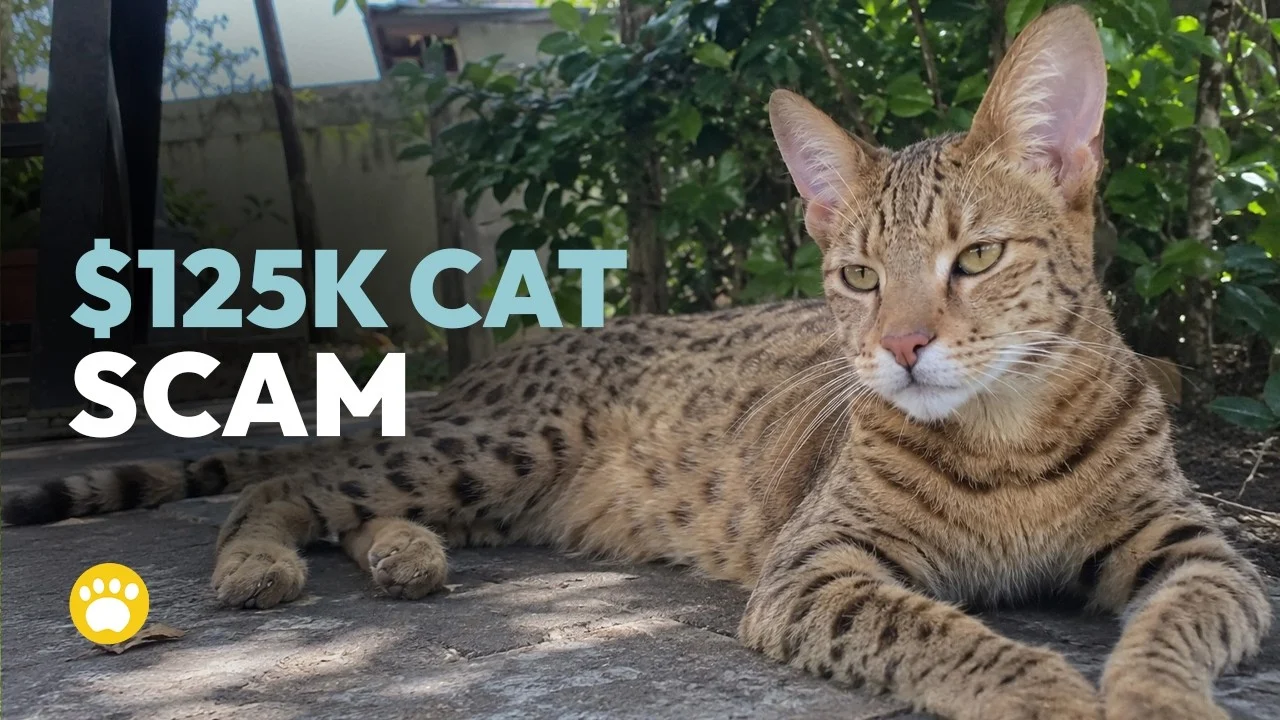
There’s a cat that has been advertised for more than $125,000. The Ashera sits at the top of nearly every list of the world’s most expensive cats, with quoted prices from $22,000 into six figures. Buyers were told they were getting something almost unavailable. The truth: almost the entire price came from a name.
The pitch
The Ashera was announced in 2006 by a Delaware-registered company called Allerca, later Lifestyle Pets. It was described as a cross between an African serval, an Asian leopard cat and a domestic cat, standing three to four feet tall on its hind legs and weighing up to 33 pounds. Only a handful were supposedly produced each year, and a pricier version was marketed as hypoallergenic. The company sold the Ashera for $26,950. Major networks covered it, and Time listed the company’s cats among its Best Inventions of 2006.

The man behind it
Simon Brodie had been convicted in the UK in 1994 on seven counts of false accounting tied to the collapse of a hot-air balloon company. A 2006 San Diego Union-Tribune investigation found defaults, evictions, lawsuits and unpaid debts. No breeding records were ever released, and no cat registry has ever recognized the Ashera as a breed.

Caught at the airport
In January 2008, Dutch customs officials at Schiphol seized three kittens imported as Asheras. One had been bought by a couple from Eindhoven for around $22,000. Pennsylvania breeder Chris Shirk saw the photos and recognized a first-generation Savannah cat, born at his home on September 3, 2007, from his serval and his Egyptian Mau. In June 2008, forensic labs confirmed all three kittens traced back to his cats, with no Asian leopard cat markers at all.
The allergy claim
All cats produce Fel d 1, the protein behind the large majority of human cat allergies, regardless of breed, coat or size. There’s no allergen-free cat. In July 2013, ABC News had cats bought from the company tested and found ordinary Fel d 1 levels. That investigation tracked Brodie to London under a new name, still selling “Asheras” for about $7,000. A photo he sent was traced by its geotag to a local listing for the same kitten at $260.
What buyers actually got
- Ashera price $22,000 to $125,000+ claimed
- Actual cat Usually a first-generation Savannah
- F1 Savannah About $12,000 to $20,000, with papers
- Later generations Roughly $2,000 to $5,000
- Company Stopped orders 2009, closed 2015
The takeaway
A registry can’t set a price, but it does verify parentage, and a cat with no registry behind it has no record of what it is. Any spotted hybrid can be photographed, called an Ashera and priced at whatever a buyer accepts. What those buyers paid the extra tens of thousands for was a story.