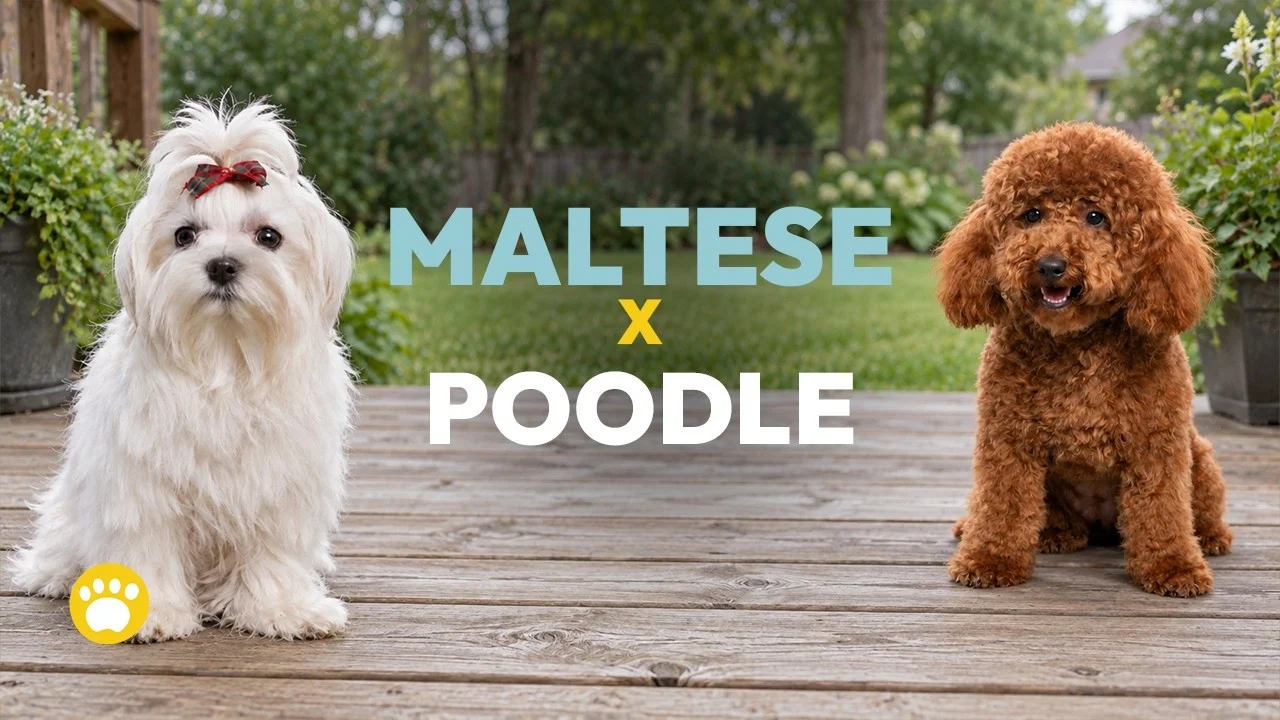
Two Maltipoo puppies can come out of the same litter and grow into two completely different dogs. One has a tight curly coat that never drops a hair. The other sheds like any small dog. Same parents, same price tag. That happens because the Maltipoo has no breed standard and no kennel club recognition behind the name.
Maltipoo at a glance
- Cross Maltese × Toy or Miniature Poodle
- Height 8 to 14 inches
- Weight 5 to 20 pounds
- Lifespan 12 to 16 years
- Price $1,000 to $4,000 from a health-testing breeder
Two very different parents
The Maltese descends from a small white lapdog that appears constantly in Greek and Roman records, written about by Aristotle and Pliny the Elder; the Roman governor of Malta, Publius, owned one named Issa. Genomic researchers have since concluded the modern Maltese can’t be traced by pedigree to those ancient dogs. It was assembled in the Victorian era.
The Poodle came out of Germany as a duck retriever, its name from the German pudeln, to splash in water. That famous clip started as function: hunters shaved the legs so the dog could move through cold water and left thick hair over the joints for warmth.
Why the coats vary so much
Two genes do most of the work. The furnishings gene (RSPO2) produces the mustache and eyebrows people associate with Poodle crosses. The curl gene (KRT71) controls texture. Both are dominant. A Poodle carries two copies of each and a Maltese carries no furnishings, so a first-generation cross gets one copy and reliably looks the part. Breed two of those together and flat-coated, bare-faced puppies resurface at designer prices.

The “hypoallergenic” myth
- A 2011 study in the American Journal of Rhinology and Allergy found no meaningful difference in allergen levels between homes with so-called hypoallergenic breeds and other homes.
- A 2012 Dutch study in the Journal of Allergy and Clinical Immunology measured Can f 1, the main dog allergen, in hair samples. Poodles carried higher levels than Labrador Retrievers.
- The allergen lives in skin cells, saliva and urine, not in the hair.
Grooming is the real workload
Hair that would normally fall out stays trapped and twists into mats behind the ears, under the harness and in the armpits. Brush three to four times a week minimum, daily for curly coats, with a professional groom every four to eight weeks. Between six and fourteen months, the puppy coat is replaced by the adult texture and the two tangle together.

Temperament
Maltipoos bond hard and don’t handle long stretches alone. Separation anxiety is the most common complaint, showing up as barking, chewing and house soiling. They’re alert barkers who announce every delivery driver. Training goes well because they’re smart and eager, but they shut down under harsh correction.
Health
- Dental disease leads the list: the same 42 teeth as a German Shepherd in a jaw a few inches long.
- Patellar luxation shows up as a skipping hop on a back leg.
- Progressive retinal atrophy comes from the Poodle line and can be screened by DNA test.
- Tracheal collapse and low blood sugar in tiny puppies also appear.
Scam warning signs
A $300 listing, payment by wire transfer, or any puppy offered before eight weeks old.
The takeaway
Get one whose parents were screened for knees and eyes, and start brushing and handling its teeth the week it comes home, while it still weighs four pounds and can’t argue with you about it.