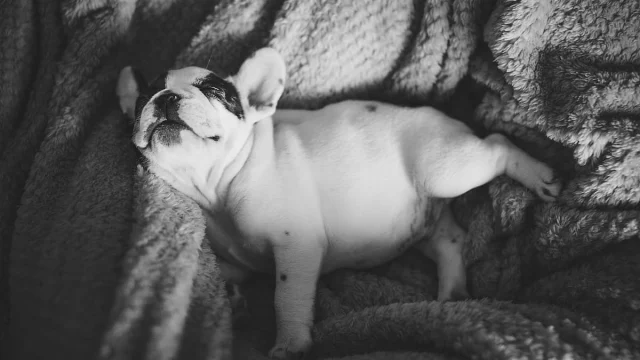
Your dog lies down on the rug, stretches its front legs out, and then lays one paw neatly over the other. It looks polite, almost human, as if your dog is waiting for a meeting to start. Some dogs do it every time they rest. Others never do it at all.
No large study has looked at paw crossing on its own, but vets and behavior experts agree on the main reasons behind it, and on the times it is worth a closer look.
It is a comfortable way to lie
The simplest explanation is comfort. When a dog lies on its chest with its front legs straight out, its weight presses on the elbows and shoulders. Turning the elbows slightly outward and laying one paw over the other changes where that pressure falls. Behavior experts compare it to the way people shift around or cross their legs after sitting in a chair for a while.
Many dogs cross their paws after they have been lying in the same position for some time. If you watch closely, you may see your dog start with its paws side by side and switch to crossed paws a few minutes later.
It shows your dog feels relaxed
Dogs that are nervous or on guard usually keep their front legs under them, ready to stand up quickly. A dog lying with its paws crossed has put its feet in a position that takes a moment longer to get out of. That tells you it feels safe where it is.
Look at the rest of the body to confirm it. A relaxed dog with crossed paws usually has soft eyes, a loose mouth, ears in their normal position, and a body that is not stiff. Many dogs rest their chin on their crossed paws and doze off.
Body shape plays a big part
Dogs with long legs and narrow chests cross their paws much more often than short-legged dogs. Greyhounds, Whippets, Dobermans, Labrador Retrievers, Golden Retrievers and German Shepherds are often seen with crossed paws. A narrow chest means the front legs sit close together, so one paw slides over the other easily. Long legs also have more room to move.
Short-legged breeds such as Dachshunds, Corgis and Basset Hounds rarely cross their paws. Their legs are short and set wide, so crossing them is awkward. If your Dachshund never does it, there is nothing wrong.
Some dogs learn that it gets attention
Crossed paws look cute, and people tend to react. Owners often smile, take a photo, say “aww,” or give a treat when they see it. Dogs repeat things that bring good results, so a dog that is praised for crossing its paws may start doing it more often.
Some people also wonder if dogs copy their owners crossing their legs. Dogs can imitate people. A 2010 study by researchers in Vienna and Oxford found that trained dogs copied the way their owners opened a door, even when copying cost them a treat. That study looked at specific actions after a lot of training, though. There is no research showing that dogs copy the way we sit or cross our legs.
Crossing paws on command
“Cross your paws” is a popular dog trick, and it is easy to teach to a dog that already does it on its own. The American Kennel Club suggests saying “cross,” then praising and rewarding your dog every time you see it lying with crossed paws. Over time, your dog connects the word with the position.
For dogs that do not cross their paws naturally, trainers often:
- Ask the dog to lie down and place a small treat or target just to the side of one paw, so the dog reaches across with the other paw.
- Reward the moment one paw lands over the other.
- Add the word “cross” once the dog does it reliably, and slowly fade out the target.
- Keep sessions short, around five minutes, and stop while the dog is still having fun.
Dogs with short legs or stiff joints may find this trick uncomfortable, so skip it if your dog resists.
When paw crossing may signal pain
Most paw crossing is harmless. Occasionally, a dog rests one paw on top of the other to keep weight or pressure off a sore foot or leg. Talk to your vet if:
- Your dog suddenly starts crossing its paws when it never did before, and always puts the same paw on top.
- It licks or chews one paw, or the paw looks red or swollen.
- It limps, holds a front leg up, or is stiff after lying down.
- It seems reluctant to lie down or get up.
Stiffness in the front legs after rest is one of the early signs of elbow dysplasia, a joint condition that often shows up in large, fast-growing dogs between about 6 and 12 months of age. Arthritis can cause the same signs in older dogs.
Crossing the legs while walking is different
Crossed paws while lying down are normal. A dog whose legs cross over each other while it walks or stands is a different matter. When the back legs cross, scuff, or the dog stands with its paws knuckled over, it can mean the dog is losing its sense of where its feet are. Vets call this a proprioceptive deficit.
This can be an early sign of a spinal or nerve problem. One example is degenerative myelopathy, a slow-moving disease of the spinal cord that often starts in dogs around 8 to 11 years old with crossing of the back legs and mild weakness in the hindquarters. Neck and back problems and some injuries can cause similar signs. If your dog’s legs cross or stumble while it walks, book a vet appointment so it can have a neurological exam.