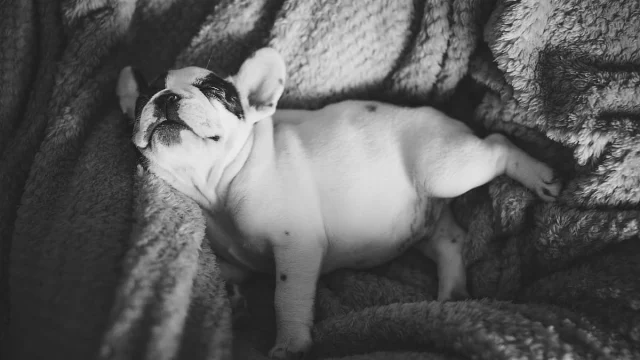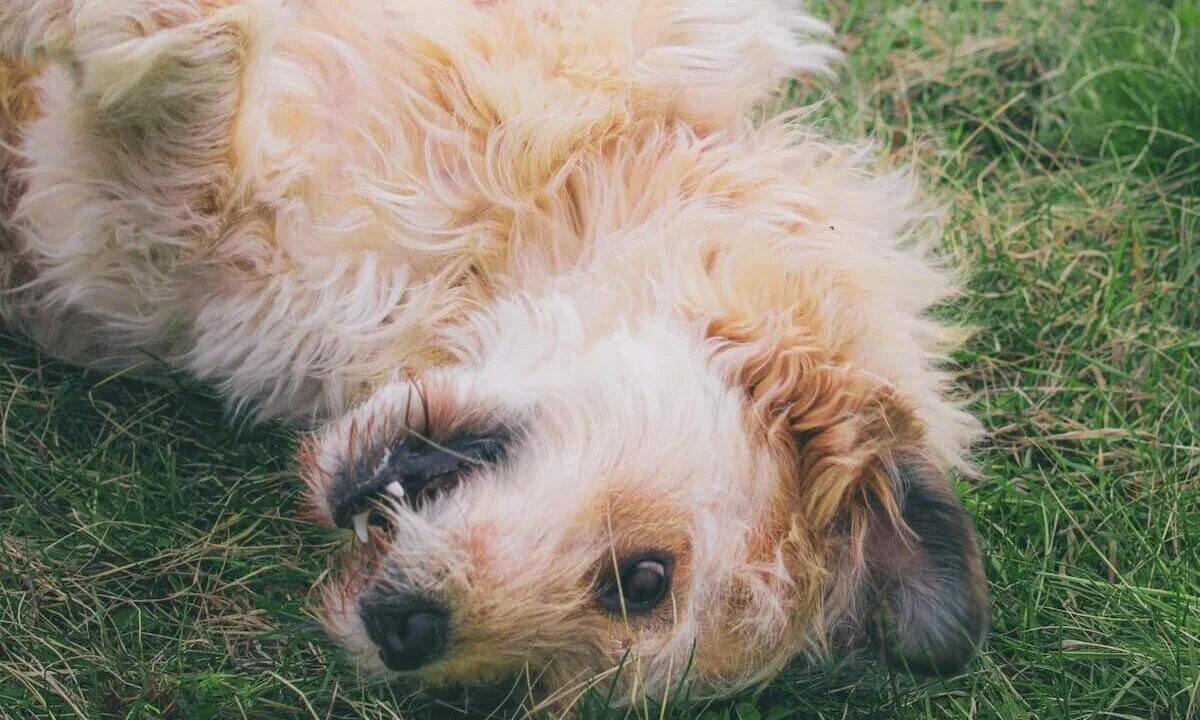
You are rubbing your dog’s belly, your fingers find one particular spot, and suddenly a back leg starts pedaling in the air. Move your hand a few inches and it stops. Go back and it starts again. Many owners call it the “sweet spot,” and some dogs have more than one.
The kicking looks like your dog is helping you scratch, but your dog is not choosing to do it. It is a reflex, much like the way your leg jumps when a doctor taps just below your knee.
The scratch reflex
Vets call this the scratch reflex. Just under a dog’s skin are nerves that sense touch and itch. When you scratch or tickle a certain area, those nerves send a signal to the spinal cord. The spinal cord answers right away by telling the back leg on that side to make a scratching motion.
The signal does not need to travel up to the brain first. The pattern for scratching is wired into the spinal cord itself. Scientists know this because the reflex still works in laboratory animals whose spinal cord has been separated from the brain. That is why the leg starts moving before your dog has had any chance to think about it, and why most dogs cannot stop it.
A reflex studied for more than 100 years
The scratch reflex is one of the best-known reflexes in science. British scientist Charles Sherrington studied it in dogs in the early 1900s. He mapped the area of skin that triggers the kick, which runs mostly along the belly, sides and back, and he described the reflex in his 1906 book The Integrative Action of the Nervous System. Sherrington later shared the 1932 Nobel Prize in Physiology or Medicine for his work on how nerves communicate.
Why dogs have it
The most likely purpose is protection from pests. Dogs cannot reach every part of their body with their mouth, and they do not have hands. When a flea, tick, mosquito or burr touches the skin, an automatic scratch with the back foot can knock it off without the dog having to notice it first.
Your fingers happen to set off the same nerves that a crawling insect would. The dog’s body responds as if there is something to scratch away, even though there is nothing there.
Where the sweet spot is
The spot is different for each dog. It is most often on the belly, on the side of the chest just behind the ribs, or on the flank in front of the back leg. Some dogs kick when scratched near the base of the tail or on the chest. The spot is usually on the same side as the leg that kicks.
Does your dog enjoy it?
The kick by itself does not tell you whether your dog is enjoying the scratch. It is an automatic response, so it happens either way. Some vets think that setting the reflex off over and over may be a little annoying or startling for some dogs, the way being tickled can be for people.
The rest of your dog’s body gives a better answer. A dog that likes the attention usually:
- Rolls over and offers its belly on its own.
- Has a loose, wiggly body, soft eyes and a relaxed mouth.
- Nudges your hand or moves back into place when you stop.
A dog that would rather you stop may go stiff, tuck its tail, pull its ears back, lick its lips, look away, or walk off. If you see those signs, scratch somewhere else, such as the chest or behind the ears, where the reflex is not triggered.
Vets use it to check the nerves
Because the scratch reflex depends on working nerves and a healthy spinal cord, vets can use it as one of many simple checks during an exam. A normal kick is a good sign that the nerves in that area are sending and receiving signals. A missing or very weak reflex on one side may lead a vet to look more closely for a nerve or spine problem, along with other reflex tests and a full neurological exam.
When the kicking is a sign of something else
Itchy skin
A dog with itchy skin can have a reflex that goes off very easily. Veterinarians note that dogs with allergies tend to kick at the lightest touch because their skin is already close to itching. If your dog kicks at almost any touch, also scratches a lot on its own, or chews its paws, look for:
- Fleas or flea dirt, which looks like specks of black pepper, especially near the base of the tail.
- Red, flaky or greasy skin, or bald patches.
- Ear scratching, head shaking or a smell from the ears.
Skin allergies, flea allergy and skin infections are common and treatable, so it is worth a vet visit if the itching does not settle.
Scratching at the air
Some dogs make a scratching motion toward the neck or shoulder without their foot touching the skin. This “phantom scratching” is a known sign of syringomyelia, a condition in which fluid-filled pockets form inside the spinal cord. It is most common in Cavalier King Charles Spaniels and other small breeds. A 2017 study in BMC Veterinary Research found that phantom scratching in Cavaliers was linked to fluid pockets in a particular part of the spinal cord in the neck.
Talk to your vet if your dog often scratches at the air, yelps when its neck is touched, or seems to have neck pain. An MRI scan is usually needed to diagnose syringomyelia.
A change from normal
Call your vet if your dog’s usual kick suddenly disappears, if one back leg seems weak or wobbly, or if your dog starts crossing or dragging its back feet when it walks. These can be signs of a spinal problem and are worth checking soon.
Finding the spot without annoying your dog
- Let your dog decide. If it rolls over for a belly rub, go ahead. If it stays standing or moves away, pet its chest or shoulders instead.
- Scratch gently and stop every few seconds to see whether your dog asks for more.
- If the kicking seems to make your dog jumpy, move your hand an inch or two away from the spot.
- Teach children to stop if the dog gets up, stiffens or walks away.